The Iran War Probability and the Financial System: Could a Cheap Drone War Trigger a Global Collapse?
The Economics of Modern War Are Changing And That Matters for Markets
For decades, wars between major powers were measured in industrial capacity, aircraft carriers, and fighter jets.
But the emerging conflicts in the Middle East and Eastern Europe are revealing something far more dangerous to global financial stability: asymmetric cost warfare.
In simple terms, the side that spends the least may actually win.
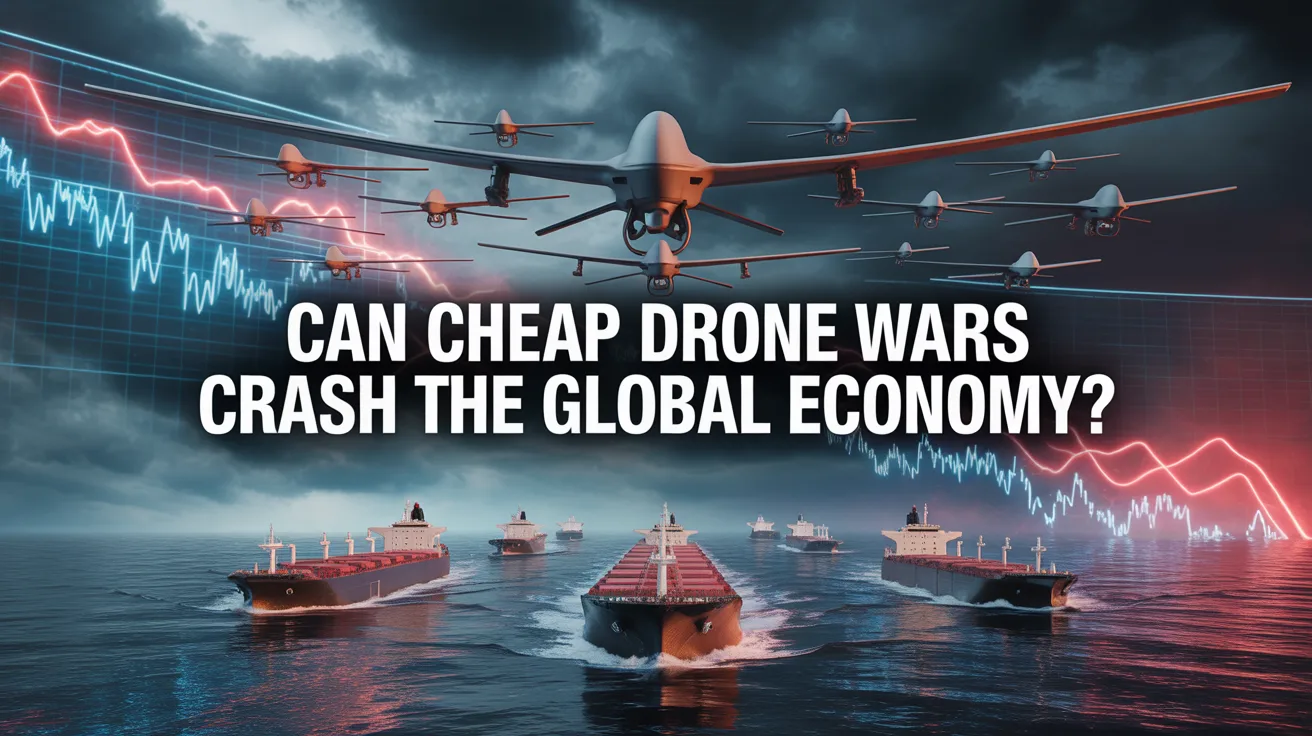
Iran has built an arsenal of inexpensive drones capable of overwhelming modern air defense systems. Some analysts estimate these drones cost roughly $20,000–$50,000 each, while the interceptor missiles used to shoot them down can cost $3 million to $15 million per shot.
That means the defending country may spend 100–200 times more money than the attacker simply to stay alive.
And that cost imbalance has enormous implications for the global financial system.
The Motorcycle Engine Problem
Many Iranian drones use simple internal-combustion engines, sometimes adapted from small vehicles like motorcycles or hobby aircraft engines. This makes them:
- cheap
- easy to mass-produce
- difficult to stop in large numbers
Modern missile defense systems, however, rely on extremely complex technologies:
- advanced radar
- precision guidance
- high-speed interceptors
- integrated satellite networks
These systems are incredibly effective but they are also incredibly expensive.
A single Patriot interceptor missile can cost around $4 million, compared with a drone that costs only a few tens of thousands of dollars.
This imbalance creates a strategic problem known as the cost-exchange ratio.
If a nation launches 100 drones costing $2–5 million total, the defending country may spend $300–400 million intercepting them.
In warfare, that’s not just a military challenge – it’s a financial sustainability problem.
What Happens If This Becomes a Protracted War?
History shows that financial markets hate long wars.
Examples include:
- The 1973 oil crisis
- The Iraq War surge period
- The 2008 financial crisis overlapping global instability
A prolonged conflict could trigger several economic shockwaves:
1. Energy Market Disruption
Iran sits near the Strait of Hormuz, through which about 20% of global oil supply flows.
If shipping lanes are threatened:
- Oil prices spike
- Transportation costs surge
- Inflation accelerates globally
2. Defense Spending Explosion
Wars require massive government spending.
During the first 100 hours of a potential large-scale conflict, analysts estimated costs could reach $3.7 billion.
Multiply that across months or years, and the fiscal burden becomes enormous.
3. Debt Markets Begin to React
War spending historically increases:
- government borrowing
- treasury issuance
- interest rates
When governments borrow heavily during uncertain periods, bond markets often become unstable.
4. Stock Market Volatility
Wars create supply chain disruptions and geopolitical uncertainty – both of which investors hate.
If the war drags on:
- corporate earnings decline
- global trade slows
- capital flows to safe assets
Could This Trigger a Financial Collapse?
A collapse rarely happens from a single event.
Instead, crises usually occur when multiple stresses hit the system simultaneously.
For example, in 2008:
- housing collapse
- credit freeze
- banking insolvency
- derivatives exposure
A war in the Middle East could trigger a similar chain reaction:
- Energy shock
- Inflation surge
- Central bank policy tightening
- Credit contraction
- Market sell-off
If global financial markets are already fragile, the result could resemble a systemic correction or crisis.
The Strategic Lesson for Investors
The lesson isn’t that war automatically causes financial collapse.
The real lesson is:
Modern warfare has become economically asymmetric.
Cheap weapons are now capable of imposing massive financial costs on technologically advanced nations.
And when governments spend heavily while markets are already overvalued, the probability of financial instability increases dramatically.
Final Thought
As investors and business leaders, we must remember:
The battlefield and the balance sheet are now deeply connected.