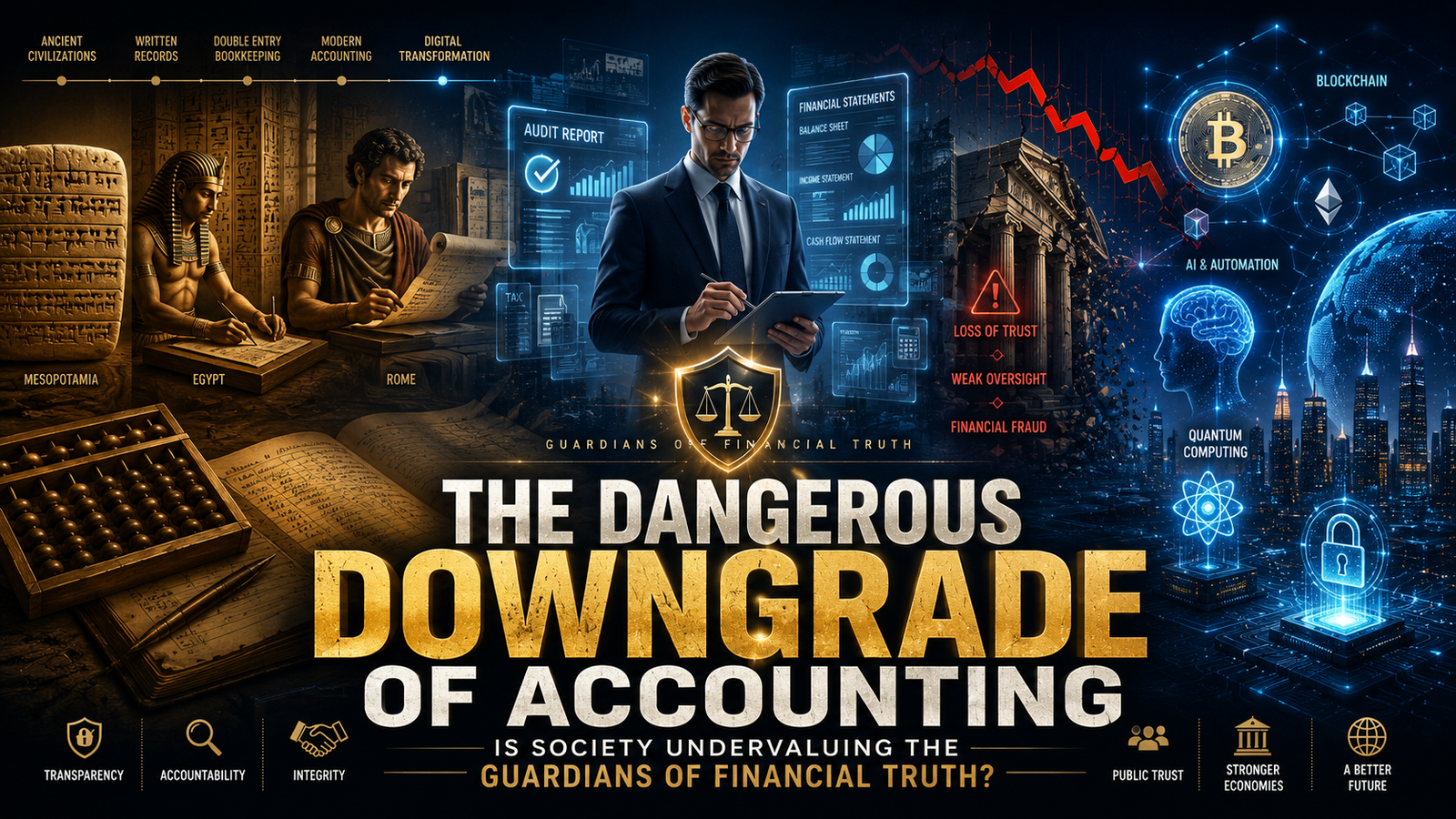
The Dangerous Downgrade of Accounting: Is Society Undervaluing the Guardians of Financial Truth?
The Dangerous Downgrade in accounting rarely captures headlines. It is not surrounded by the glamour of artificial intelligence, the prestige of medicine, or the excitement of emerging technology startups. For most people, the word accounting immediately creates images of spreadsheets, calculators, tax forms, and endless rows of numbers. It is often viewed as routine work operating quietly in the background of business and finance.
However, history tells a very different story.
Accounting is far more than balancing books and preparing financial reports. It is one of civilization’s oldest systems of trust. Long before modern banking systems, stock exchanges, digital payments, or multinational corporations existed, societies depended on recordkeepers to preserve transparency and accountability.
Today, a controversial shift has raised an important question. Following the U.S. Department of Education’s decision to reclassify accounting as a “non-professional” degree category for federal student loan purposes, many professionals are asking whether society is beginning to underestimate the very people responsible for protecting financial truth.
Because accounting has never simply been about numbers.
It has always been about trust.
Accounting Helped Build Civilization Before Modern Economies Existed
Thousands of years before modern finance emerged, civilizations understood the importance of maintaining records and tracking economic activity. Ancient societies relied heavily upon trusted systems to monitor resources, taxes, trade, and obligations.
Merchants in Mesopotamia recorded grain inventories using clay tablets. Egyptian scribes documented labor distributions and taxation systems. Roman officials managed census records, military expenditures, and public infrastructure projects throughout their expanding empire.
Even Roman soldiers, who at times were compensated in salt the origin of the modern word “salary” required systems capable of tracking payments and obligations.
These systems may seem primitive compared to modern financial software, but their purpose was identical: To preserve trust.
Before governments could collect taxes or build infrastructure, they first needed systems capable of documenting resources and economic activity.
Some historians even suggest written language itself partially evolved because societies needed methods for documenting transactions and commercial relationships.
Accounting was not built on top of civilization.
Accounting helped create civilization itself.
As centuries passed, technologies changed:
- Clay tablets evolved into written ledgers
- Ledgers evolved into bookkeeping systems
- Bookkeeping evolved into spreadsheets
- Spreadsheets evolved into digital financial ecosystems
Yet despite technological progress, the mission remained unchanged: Protect financial truth.
Why Accountants Have Always Been Silent Guardians of Trust
Unlike lawyers arguing in courtrooms or doctors working in hospitals, accountants often operate quietly behind the scenes.
Their work rarely attracts public attention.
But their responsibilities have always extended beyond calculations.
Accountants stand between:
- Transparency and manipulation
- Accountability and corruption
- Financial truth and financial illusion
History repeatedly demonstrates their importance.
One of the most famous examples involved Al Capone.
Authorities struggled for years to prosecute Capone for violent crimes and organized criminal activity. Yet traditional approaches repeatedly failed.nEventually, financial records and tax investigations succeeded where everything else had not.
Accounting evidence ultimately became the mechanism through which prosecutors secured his conviction.
Similarly, investigations involving John Gotti increasingly relied upon financial scrutiny and forensic methods.
These cases reveal an important lesson: Money leaves evidence. And accountants understand where to find it.
Financial Crises Repeatedly Reveal the Importance of Oversight
History follows a pattern that becomes increasingly difficult to ignore.
Many of society’s largest financial collapses share similar characteristics:
- Weak oversight systems
- Manipulated reporting
- Reduced transparency
- Failures in accountability
When financial systems become difficult to verify, risk expands rapidly.
Following the economic devastation of the Great Depression, governments introduced reforms intended to restore confidence and strengthen regulation.
Years later, corporate disasters including the Enron scandal and the WorldCom accounting scandal once again exposed weaknesses in financial accountability.
These scandals reshaped corporate regulation and emphasized the importance of stronger financial oversight.
Every major financial crisis teaches the same lesson:
Without accountability, trust becomes fragile.
Accounting often functions as civilization’s financial immune system detecting weaknesses before they spread further.
The Rise of Cryptocurrency and AI Is Making Financial Systems More Complex
Ironically, accounting now faces unprecedented challenges at the exact moment financial systems are becoming more technologically advanced.
Modern finance no longer revolves solely around banks and traditional assets.
Today’s ecosystem increasingly includes:
- Cryptocurrency
- Blockchain technology
- Decentralized finance
- Smart contracts
- Tokenized assets
- AI-generated financial reporting
- Algorithmic trading systems
Financial products are becoming increasingly abstract. Money itself is becoming increasingly digital. Transactions increasingly occur within invisible technological environments.
As complexity grows, one question becomes increasingly important:
- Who validates financial truth?
- Who confirms accuracy?
- Who protects accountability?
- Because technological innovation does not eliminate the need for trust.
- In many ways, it increases it.
Modern Financial Scandals Reveal Dangerous Weaknesses
Recent financial events demonstrate exactly why accountability remains essential. The collapse of FTX and the downfall of Sam Bankman-Fried exposed major weaknesses involving governance, internal controls, and transparency. Similarly, the enormous Ponzi scheme operated by Bernie Madoff remained hidden for years beneath layers of reputation and institutional trust.
These scandals exposed more than individual misconduct.
They revealed systemic vulnerabilities.
And they forced society to ask difficult questions:
- Who watches the books?
- Who verifies truth beneath increasingly complex financial systems?
- Who protects people when systems fail?
Historically, accountants and financial investigators acted as counterweights against unchecked power.
Weakening that pipeline creates long-term consequences.
The Accounting Profession Faces a Growing Talent Shortage
Beyond major scandals, another issue is quietly emerging. The accounting profession itself faces workforce challenges. Enrollment rates in accounting programs have declined. Participation in professional certification pathways has weakened.Meanwhile, demand for financial expertise continues increasing.
This creates an uncomfortable contradiction.
Financial systems are becoming more sophisticated at precisely the moment fewer people are entering professions designed to validate them.
The long-term consequences could extend far beyond accounting itself.
Without strong accounting systems:
- Investors lose confidence
- Fraud becomes more difficult to detect
- Businesses lose transparency
- Governments weaken oversight capabilities
- Capital markets suffer instability
- Public trust begins eroding
Modern economies function largely through confidence.
When confidence weakens, instability spreads quickly.
Financial Literacy Is Quietly Disappearing
An equally concerning trend may involve education itself. For years, financial literacy instruction gradually declined across many schools.
Many young adults now enter adulthood without understanding:
- Taxes
- Debt management
- Credit systems
- Investments
- Banking principles
- Financial statements
- Personal finance basics
Ironically, this decline occurs during a period of increasing financial complexity.
Consumers now navigate online banking, digital currencies, AI investment tools, subscription economies, and rapidly evolving financial risks. Yet many individuals lack the foundational knowledge needed to understand them. When understanding declines, trust becomes even more important. And trust requires professionals capable of protecting it.
Future Threats Could Redefine Accounting Completely
The next major challenge may extend far beyond traditional financial fraud.
Emerging technologies like quantum computing could fundamentally reshape assumptions surrounding digital security.
Modern financial infrastructure relies heavily on encryption systems protecting:
- Banking systems
- Digital assets
- Blockchain networks
- Authentication platforms
- Cryptocurrency wallets
- Financial communications
Future technological breakthroughs may challenge protections once considered nearly impossible to overcome. The accountant of tomorrow may therefore become something entirely different.
Future professionals may increasingly operate as:
- Financial investigators
- Blockchain analysts
- AI auditors
- Cyber-forensic specialists
- Digital trust architects
The profession itself may evolve dramatically. Its mission, however, will remain unchanged. Protect trust.
View More On Youtube:
Mechanics of Money Episode 12 Dyron Bush
Conclusion: Accounting Was Never Just About Numbers
Technology evolves. Markets evolve. Civilizations evolve. But trust remains one of society’s most valuable resources.
For thousands of years, accounting evolved alongside civilization itself from Mesopotamian recordkeeping systems and Roman taxation structures to modern forensic investigations and digital financial ecosystems.
- The tools changed.
- The systems changed.
- The technology changed.
- The mission never changed.
Accounting has never simply been about balancing numbers. It has always been about protecting truth. And perhaps that is why many professionals view the downgrading of accounting as more than a policy decision. Because to them, it does not feel like a simple classification adjustment. It feels like a warning sign.
Civilization once feared ignorance.
Now, we laud hubris while the barbarians breach the gates.
We turn our backs on them, dismissing nescience itself as no longer a viable threat.
Yet history has never been conquered by the impossible.
It has always fallen to the ignored
– Dyron Bush
“Non Omnis Moriar”
Truth survives through remembrance.