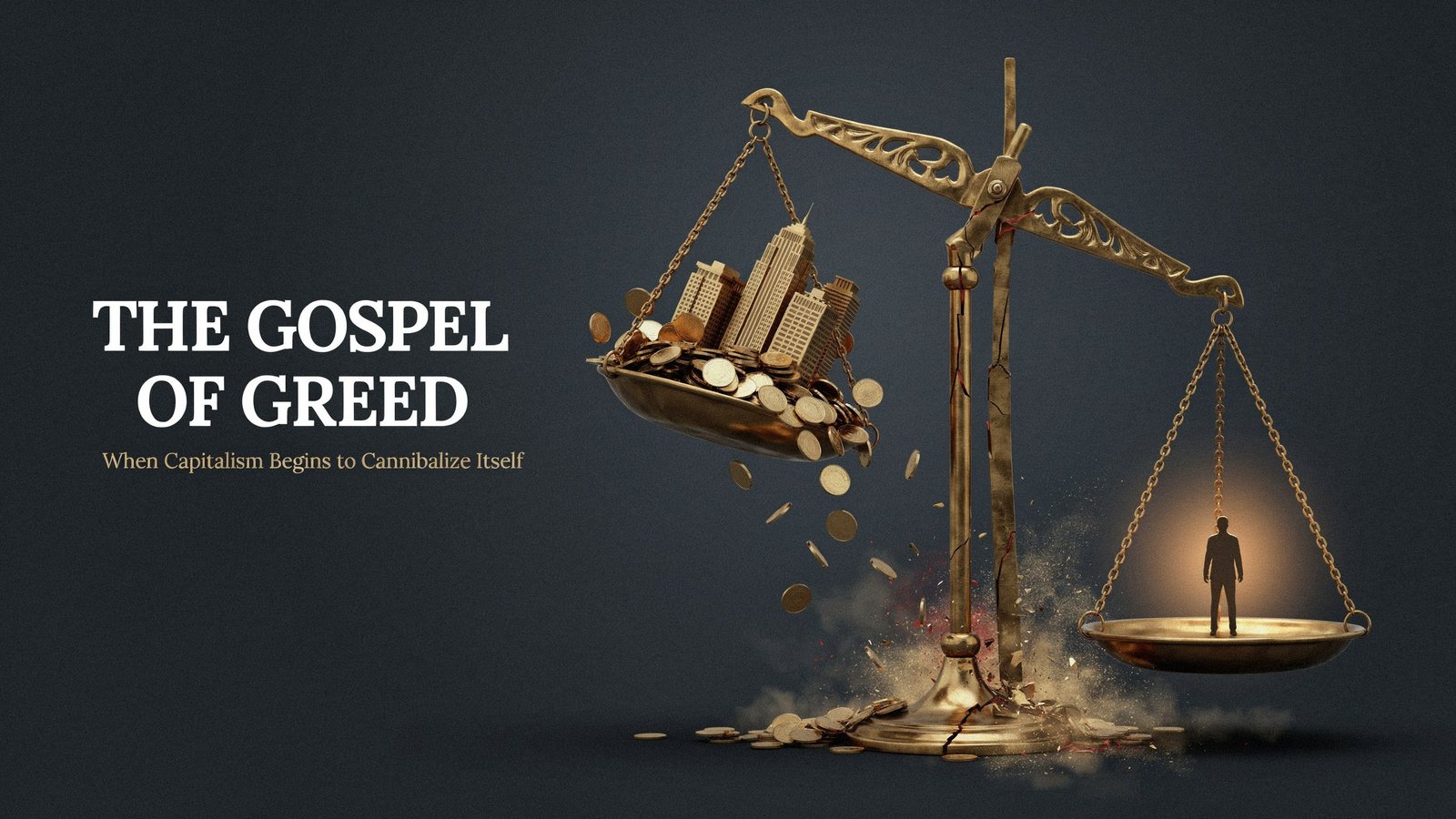
The Gospel of Greed: When Capitalism Begins to Cannibalize Itself
The Ultimatum Game: When Greed Collides With Human Rationality
There is a fascinating experiment in behavioral economics known as the Ultimatum Game, and I believe it reveals something profoundly unsettling about the relationship between greed, rationality, and human behavior.
The premise is deceptively simple.
Two individuals are presented with a sum of money, say $100. One participant, the proposer, determines how the money will be divided. The second participant, the responder, has only two choices: accept the proposed division or reject it entirely.
If the responder accepts, both participants receive their respective shares.
If the responder rejects, neither participant receives anything.
Consider a proposer who offers the responder $10 while retaining $90.
Under the conventional assumption that individuals seek to maximize their immediate monetary payoff, the responder should accept the $10. After all, receiving $10 is financially preferable to receiving nothing.
But human beings are not always governed by such narrowly defined economic rationality.
Experimental research has repeatedly demonstrated that responders frequently reject offers they perceive as excessively unfair, particularly when those offers represent a small fraction of the available money.
In other words, individuals will sometimes willingly sacrifice their own financial benefit to punish what they perceive as another person’s greed.
I find this extraordinary.
The proposer may believe that retaining $90 represents a rational exercise of economic self-interest.
The responder may regard the same proposal as an intolerable expression of exploitation.
Both individuals are acting upon competing interpretations of value.
And therein lies the contradiction.
Greed may motivate the proposer to demand a disproportionate share, while resentment toward perceived greed may motivate the responder to destroy the economic benefit available to both.
The result is a mutually destructive outcome.
Neither participant receives anything.
The Paradox of Rational Greed
What fascinates me about the Ultimatum Game is that it challenges the assumption that maximizing one’s personal share necessarily produces the greatest attainable economic benefit.
A proposer who insists upon keeping $90 may ultimately receive nothing.
A proposer who offers $50 may receive less than the maximum theoretically available, but substantially increase the likelihood of an accepted agreement.
Of course, fairness is not the only consideration. Proposers may offer equitable divisions because they genuinely value fairness, because they anticipate rejection, or because they are strategically protecting their own expected payoff.
Similarly, a responder’s rejection of an unfair offer need not be irrational.
If an individual derives satisfaction from enforcing fairness or discouraging exploitation, rejection may reflect preferences extending beyond immediate monetary compensation.
This distinction is important.
Traditional economic reasoning does not necessarily fail because people reject unfair offers. Rather, the experiment demonstrates the limitations of defining utility exclusively in monetary terms.
And that brings me directly back to my earlier question:
“One has to wonder if the economic precept of marginal utility covers the insatiable gulf of greed.”
The Ultimatum Game suggests that economic value cannot always be understood through the accumulation of money alone.
Power, dignity, reciprocity, punishment, and perceived justice can influence economic decisions.
Yet I would take the argument one step further.
When greed becomes excessive, it may cease to be economically advantageous even to the individual exhibiting it.
The proposer who demands too much risks receiving nothing.
The corporation that extracts excessive value from its customers risks losing their loyalty.
The employer who relentlessly suppresses compensation risks undermining employee productivity and retention.
And the financial institution that pursues extraordinary returns through excessive leverage risks destroying the capital it sought to multiply.
These are not identical situations, nor does the Ultimatum Game establish that every instance of aggressive profit-seeking produces economic collapse.
But the underlying behavioral warning is unmistakable.
The pursuit of maximum individual gain can provoke responses that reduce, or even eliminate, the gains available to everyone.
Capitalism’s Ultimatum
I see a broader economic parallel.
Corporations, investors, workers, and consumers continually negotiate how economic value will be distributed.
The bargaining power of these participants is rarely equal.
Some control capital. Others supply labor. Some possess market dominance. Others have limited alternatives.
And unlike the simplified Ultimatum Game, participants in the real economy cannot always reject an unfavorable arrangement without suffering substantial consequences.
That difference makes the comparison even more troubling.
A worker may accept inadequate compensation because unemployment would be financially devastating.
A consumer may tolerate excessive prices because an essential service has few substitutes.
A small supplier may accept unfavorable contractual terms because losing a dominant customer would threaten its survival.
Acceptance, therefore, should not automatically be interpreted as satisfaction or fairness.
Sometimes acceptance merely reflects the absence of a viable alternative.
Over time, however, perceived inequities can generate resistance through employee turnover, labor disputes, consumer boycotts, political pressure, or demands for regulatory intervention.
These responses may impose costs upon the very institutions that originally benefited from their superior bargaining positions.
And this is where the Ultimatum Game becomes particularly relevant to my broader argument about capitalism cannibalizing itself.
A system that continually rewards the extraction of an ever-larger share of economic value may eventually undermine the cooperation required to create that value.
Capitalism depends upon exchange.
Exchange depends, in part, upon trust, enforceable agreements, and the willingness of participants to continue engaging with one another.
When those foundations deteriorate, economic relationships become increasingly adversarial.
The consequences can extend beyond a single transaction.
Perhaps greed’s greatest economic failure is not that it demands too much, but that it eventually destroys the willingness of others to participate in the exchange.
In the Ultimatum Game, the final consequence is immediate.
Both players walk away empty-handed.
In capitalism, the consequences can take considerably longer to emerge.
But the question remains remarkably similar.
How much can one participant extract before the arrangement itself becomes unsustainable?
I would argue that this is not merely a question of economics.
It is a question of human behavior, institutional design, and the limitations of rational self-interest.
And perhaps the most revealing irony is that the individual who believes he is maximizing his economic advantage may ultimately be engineering his own financial defeat.
La cupidité peut devenir son propre châtiment.
Greed can become its own punishment.