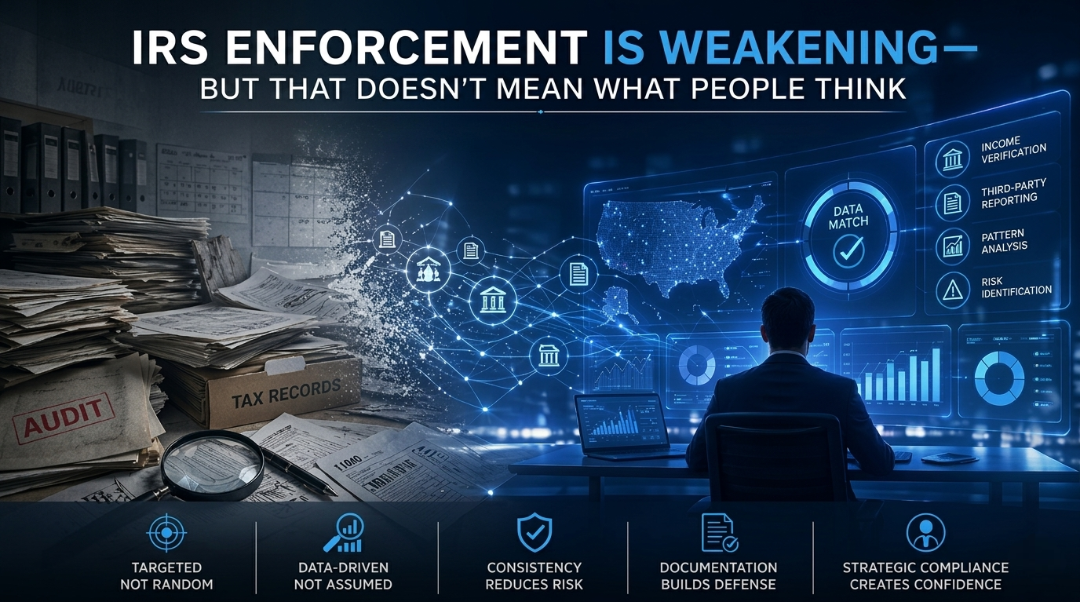
IRS Enforcement Is Weakening – But That Doesn’t Mean What People Think
In 2026, a subtle yet highly consequential shift has taken place within the Internal Revenue Service’s enforcement landscape. On the surface, the data appears straightforward: fewer audits are being conducted, staffing shortages continue to affect operational capacity, and case backlogs remain unresolved. To many taxpayers, this paints a clear picture IRS enforcement is weakening.
But that conclusion, while understandable, is dangerously incomplete.
What is actually happening is not a simple decline in enforcement, but a transformation. The IRS is evolving from a broad, volume-driven enforcement model into a far more focused, intelligence-based system. And in many ways, this new approach is more precise, more strategic, and potentially more impactful than what came before.
The Illusion of Reduced Oversight
Historically, IRS enforcement relied on a relatively wide net. Audits were distributed across various income levels, industries, and taxpayer categories. While not entirely random, there was enough unpredictability to create a general sense of caution among taxpayers.
That unpredictability played an important role. It reinforced compliance not necessarily because every taxpayer expected to be audited, but because anyone could be.
Today, that dynamic is changing.
Due to budget constraints, staffing challenges, and operational limitations, the IRS no longer has the capacity to maintain the same volume of traditional audits. As a result, the number of audits has declined, particularly among certain income groups.
This decline, however, has created a misleading perception: that enforcement itself is weakening or becoming less relevant.
In reality, the opposite is happening.
The Rise of Intelligence-Based Enforcement
Instead of casting a wide net, the IRS is now focusing on precision. Modern enforcement strategies rely heavily on advanced data analytics, machine learning algorithms, and automated cross-referencing systems.
These tools allow the IRS to process vast amounts of financial data quickly and efficiently. More importantly, they enable the agency to identify inconsistencies with a level of accuracy that was not possible under traditional methods.
For example:
- Income reported on tax returns is automatically compared against third-party data sources such as Forms 1099, W-2s, brokerage statements, and digital payment platforms.
- Algorithms analyze patterns within specific industries to detect anomalies or outliers.
- Behavioral trends, such as sudden changes in income, deductions, or credits, can trigger additional scrutiny.
This shift fundamentally changes how enforcement works.
It is no longer about how likely you are to be audited in a general sense. It is about whether your financial profile aligns with the data the IRS already has.
The New Definition of Risk
Under the traditional system, risk was often perceived in terms of probability: What are the chances of being audited?
Under the new system, risk is defined by precision: Does your data make sense?
This distinction is critical.
A taxpayer may feel confident because audit rates are low. But if their return contains inconsistencies whether intentional or accidental—they are far more likely to be flagged under a data-driven system.
Consider a few common scenarios:
- A freelancer reports income that does not match 1099 forms submitted by clients.
- A business claims deductions that are significantly higher than industry norms.
- A taxpayer reports minimal income but maintains a lifestyle that suggests otherwise.
- Cryptocurrency or digital payment transactions are underreported or omitted.
In each of these cases, the issue is not randomness it is inconsistency.
And inconsistency is exactly what modern IRS systems are designed to detect.
Why Fewer Audits Can Mean Greater Consequences
One of the most overlooked aspects of this shift is the nature of audits themselves.
While the total number of audits may be decreasing, the audits that do occur are becoming more targeted and more comprehensive. When a return is flagged, it is often because there is a specific, data-supported reason for further examination.
This leads to a key insight:
Fewer audits do not necessarily mean less enforcement they often mean more focused enforcement.
When the IRS initiates a review today, it is less likely to be exploratory and more likely to be investigative. The agency often already has a clear understanding of where discrepancies exist.
For taxpayers, this means:
- Audits may be more detailed and harder to resolve.
- Requests for documentation may be more specific and extensive.
- Outcomes may carry greater financial and legal consequences if discrepancies cannot be justified.
The Behavioral Shift Among Taxpayers
As visibility of enforcement declines, taxpayer behavior often changes.
It is natural for individuals and businesses to adjust their risk tolerance based on perceived oversight. When enforcement appears weaker, some may feel more comfortable taking aggressive positions, stretching deductions, or omitting certain income streams.
This is a predictable response but it is also a risky one.
The problem is not the behavior itself; it is the mismatch between perception and reality. While enforcement may appear less visible, the systems behind it are becoming more sophisticated.
In other words, the margin for error is shrinking even if the appearance of oversight is fading.
Strategic Compliance: The New Standard
In this evolving landscape, traditional approaches to compliance are no longer sufficient. Avoiding attention is not a viable strategy when attention is driven by data rather than randomness.
This is where the concept of strategic compliance becomes essential.
Strategic compliance is not about being overly conservative, nor is it about pushing aggressive tax positions. It is about alignment.
A strategically compliant tax profile is:
- Internally consistent – All elements of the return make logical sense together.
- Externally defensible – Positions can be supported with documentation and reasoning.
- Data-aligned – Information matches third-party reporting and industry benchmarks.
This approach requires a higher level of awareness and planning. It involves understanding not just tax laws, but how financial data is interpreted and analyzed within modern IRS systems.
Documentation Is No Longer Optional
In an intelligence-based enforcement environment, documentation plays a central role.
It is no longer enough to simply report numbers accurately. Taxpayers must be able to substantiate those numbers with clear, organized, and accessible records.
This includes:
- Income records from all sources
- Receipts and invoices for business expenses
- Documentation supporting deductions and credits
- Transaction histories for digital payments and cryptocurrency
The absence of documentation does not just weaken a taxpayer’s position it can significantly increase exposure during an audit.
On the other hand, well-maintained records can dramatically reduce both the duration and severity of an examination.
The Role of Advisors in a Changing Landscape
For tax professionals, accountants, and financial advisors, this shift presents both a challenge and an opportunity.
The role of the advisor is no longer limited to filing accurate returns. It now includes:
- Interpreting data trends and identifying potential risk factors
- Ensuring alignment between reported information and external data sources
- Advising clients on how to maintain consistency across their financial profiles
- Preparing clients for the possibility of targeted reviews
Advisors who understand this shift can provide significantly more value. They can move beyond compliance and into strategy helping clients navigate a system that is increasingly driven by data.
Confidence Through Clarity
There is an important psychological component to all of this.
Uncertainty creates anxiety. And for many taxpayers, the evolving nature of IRS enforcement adds to that uncertainty.
However, those who understand the system and adapt to it can operate with a much higher level of confidence.
Clarity reduces risk.
When taxpayers know that their financial data is consistent, well-documented, and aligned with expectations, they are not just less likely to be audited they are better prepared if they are.
This distinction matters.
Because in a targeted enforcement environment, preparation is often the difference between a manageable review and a costly problem.
Looking Ahead: The Future of IRS Enforcement
The transition from volume-based enforcement to intelligence-based enforcement is still ongoing. As technology continues to evolve, the IRS will likely become even more efficient in how it identifies and addresses discrepancies.
Future developments may include:
- Increased integration with financial institutions and digital platforms
- More advanced predictive analytics
- Greater reliance on real-time data reporting
- Expanded use of artificial intelligence in risk assessment
These changes will further reinforce the trend toward precision.
And as precision increases, so does the importance of alignment.
Final Thoughts
The weakening of traditional IRS enforcement does not signal an absence of oversight. It signals a transformation.
The system is becoming quieter but also smarter.
For taxpayers, this creates a new reality. Risk is no longer defined by visibility, but by consistency. Compliance is no longer about avoiding attention, but about ensuring alignment.
Those who misunderstand this shift may find themselves exposed in ways they did not anticipate. Those who adapt to it, however, gain a significant advantage.
They operate with clarity, confidence, and control qualities that are increasingly valuable in a data-driven world.