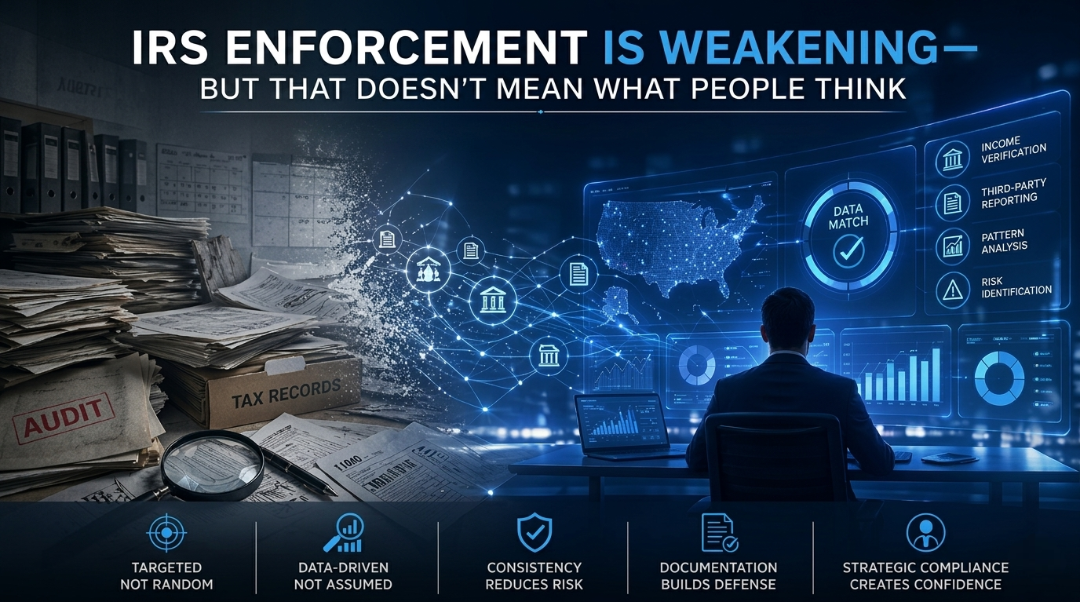
The IRS Is Watching Closely in 2026: 5 Audit Triggers High-Income Earners Can’t Afford to Ignore
In 2026, the tax landscape has entered a new era one defined not by randomness, but by precision. The Internal Revenue Service (IRS) is no longer just a regulatory body enforcing compliance; it has evolved into a data-driven, predictive system capable of identifying discrepancies in real time.
With increased federal funding, advanced AI-powered analytics, and expanded access to third-party data sources, the IRS is now focusing more sharply on high-income earners particularly individuals earning above $200,000, and even more so those exceeding $400,000 annually.
For these taxpayers, the margin for error has significantly narrowed.
What used to slip through unnoticed is now flagged instantly.
And what once triggered a manual review is now automatically analyzed against statistical norms and behavioral patterns.
The message is clear:
👉 If you’re a high-income earner, your financial activity is under a microscope.
In this blog, we’ll break down the 5 major audit triggers in 2026 that you simply cannot afford to ignore and how to stay compliant while optimizing your tax strategy.
1. Mismatch Between Income and Deductions
One of the most common and most dangerous audit triggers is a disproportionate relationship between income and deductions.
High-income individuals often use deductions strategically to minimize tax liability. While this is perfectly legal, problems arise when deductions appear excessive relative to reported income.
Why This Triggers an Audit
The IRS uses sophisticated algorithms to compare your financial profile against similar taxpayers in your income bracket. If your deductions fall significantly outside the norm, your return is flagged as an outlier.
For example:
- Claiming large charitable donations with relatively modest taxable income
- Reporting high business expenses without corresponding revenue
- Taking aggressive write-offs that don’t align with industry benchmarks
These inconsistencies raise immediate red flags.
What You Should Do
- Ensure all deductions are fully documented and justifiable
- Avoid “round number” estimates precision matters
- Work with a professional to align your deductions with industry standards
👉 Remember: It’s not about how much you deduct it’s about how well you can defend it.
2. Schedule C Reporting (Self-Employed Risks)
If you’re self-employed, a consultant, or running a side business, your Schedule C (Profit or Loss from Business) is one of the most scrutinized areas in your tax return.
Why the IRS Is Focusing Here
Self-employed individuals have more flexibility in claiming expenses which also increases the risk of misuse.
Common red flags include:
- Excessive vehicle expenses
- Overstated home office deductions
- High travel and entertainment costs
- Reporting consistent losses year after year
The IRS is particularly focused on distinguishing between:
👉 Legitimate businesses vs. hobbies
If your activity does not demonstrate a clear profit motive, your deductions may be disallowed entirely.
Key Risk Areas
- Claiming 100% business use of a vehicle
- Deducting personal expenses as business costs
- Running a “business” that never turns a profit
How to Stay Safe
- Maintain detailed records and receipts
- Separate personal and business finances
- Demonstrate a clear intent to generate profit
👉 In 2026, “I didn’t know” is no longer an acceptable excuse.
3. Cryptocurrency Reporting: No More Blind Spots
Cryptocurrency is no longer a gray area and the IRS is making that very clear.
What’s Changed in 2026?
The IRS now has:
- Access to third-party exchange data
- Advanced blockchain analysis tools
- Mandatory reporting requirements across platforms
Even minor crypto transactions are traceable.
Common Mistakes That Trigger Audits
- Failing to report crypto gains
- Ignoring small transactions
- Not converting crypto trades into taxable events
- Answering “No” to the digital asset question incorrectly
That simple question on your tax return:
👉 “Did you receive, sell, send, exchange, or otherwise acquire any financial interest in digital assets?”
This is no longer optional it’s a compliance checkpoint.
What You Must Do
- Report every taxable crypto event
- Use crypto tracking tools for accuracy
- Keep transaction logs and wallet records
👉 Even a small omission can lead to penalties or worse, a full audit.
4. Multi-State Income Allocation Issues
Remote work has transformed how people earn income and how taxes are enforced.
The Problem
Many professionals now:
- Live in one state
- Work for a company in another
- Earn income across multiple jurisdictions
This creates complex tax obligations.
Why It’s an Audit Trigger
States are becoming more aggressive in claiming tax revenue. If your income allocation is incorrect or if you fail to file in a required state it creates inconsistencies that are easily detected.
The IRS and state tax agencies now share data more efficiently than ever.
Common Mistakes
- Not filing in states where income was earned
- Incorrectly allocating income between states
- Assuming remote work eliminates tax obligations
How to Stay Compliant
- Understand state-specific tax rules
- File returns in all applicable jurisdictions
- Ensure consistency between federal and state filings
👉 Multi-state errors can lead to double taxation, penalties, and audits.
5. Aggressive Depreciation Strategies (Real Estate Focus)
Real estate investors often use depreciation to significantly reduce taxable income but in 2026, this strategy is under heavy scrutiny.
What’s Being Targeted
- Cost segregation studies
- Bonus depreciation claims
- Short-term rental classifications
While these strategies are legal, improper use or lack of documentation can trigger audits.
High-Risk Areas
- Overstating property depreciation
- Misclassifying rental properties
- Ignoring material participation rules
Short-term rentals, in particular, are being closely examined to determine whether they qualify for favorable tax treatment.
How to Protect Yourself
- Ensure all depreciation strategies are properly documented
- Work with qualified professionals for cost segregation
- Understand IRS rules around active vs. passive income
👉 Aggressive tax strategies without proper backing are a direct path to an audit.
The Bigger Picture: The IRS Is Now Predictive
The most important shift in 2026 is not just stricter enforcement it’s smarter enforcement.
The IRS is no longer reactive. It doesn’t wait for errors to surface.
Instead, it:
- Predicts risk using AI and data modeling
- Identifies patterns across millions of taxpayers
- Flags anomalies instantly
This means:
👉 You’re not being compared to rules you’re being compared to behavior.
And if your financial behavior doesn’t match expected patterns, you’re flagged.
What This Means for High-Income Earners
If you fall into the high-income category, your tax strategy needs to evolve.
You Can No Longer Rely On:
- Rough estimates
- Aggressive shortcuts
- Outdated advice
You Must Focus On:
- Accuracy
- Documentation
- Strategic planning
This is not about paying more tax it’s about reducing risk while staying compliant.
The Role of a Tax Advisor Has Changed
In this new environment, a tax advisor is no longer just someone who files returns.
They are:
- A compliance strategist
- A risk manager
- A financial architect
The right advisor helps you:
- Identify audit risks before they happen
- Structure your finances correctly
- Align your strategy with current regulations
👉 The cost of bad advice is no longer just financial it’s reputational.
Final Thoughts: Are You Prepared?
The question in 2026 is no longer:
❌ “Will I get audited?”
The real question is:
✅ “Am I prepared if I am?”
Because with today’s technology and data capabilities:
👉 Visibility is guaranteed.
Preparation is your only advantage.