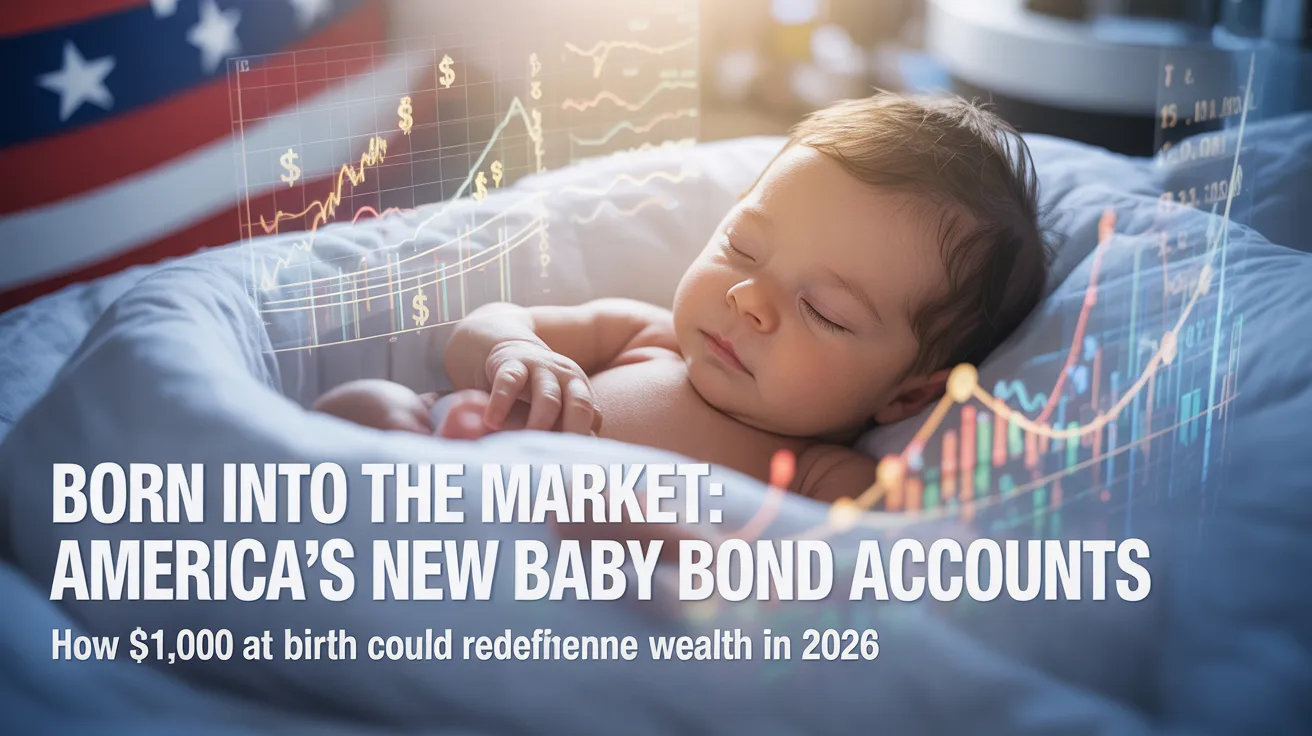
Born Into the Market: My Take on America’s New Baby Bond Accounts
I’ve spent my life around money how it moves, how it grows, how it disappears, and how it quietly determines outcomes long before people realize what’s happening.
So when I heard about the new baby bond–style accounts starting in July 2026 the so-called “Trump Accounts” under the Big Beautiful Bill didn’t just hear policy.
I heard philosophy.
Because this isn’t just about giving kids $1,000.
This is about changing what it means to be born in America.
A Child Is Now Born With Capital
For the first time in our country’s history, we are saying:
“Every child deserves not just a chance… but a stake.”
Each eligible child will receive a government-funded investment account, seeded with $1,000 and placed into the market. From there, it grows quietly, steadily, influenced by time, discipline, and the invisible hand we all talk about but few truly understand.
I’ll be honest with you I like the idea.
Not because it’s perfect.
But because it recognizes something we don’t say enough:
👉 Wealth doesn’t start when you earn your first dollar.
👉 It starts when your money starts working before you do.
And this program, at its best, does exactly that.
But I’ve Seen This Story Before
Here’s where I pause.
Because I’ve also seen what happens when opportunity is introduced… without strategy.
Yes, every child gets the same $1,000.
But I already know and you probably do too that’s where the equality ends.
Some families will:
• Max out contributions every year
• Understand how the market works
• Think long-term
Others won’t not because they don’t care, but because they don’t have the same access, knowledge, or bandwidth.
And over 18 years?
- That gap doesn’t stay small.
- It compounds.
Let Me Talk About the Tax Side Because That’s Where the Game Is Won
Now this is where I lean forward a little, because this is my lane.
Most people are going to look at this program and see an investment account.
I see a tax structure wrapped around time.
And that’s everything.
1. The Money Going In
The initial $1,000 from the government?
That’s not taxable income.
Additional contributions?
Those are likely treated as gifts, which means:
• No income tax to the child
• Subject to gift tax rules, not income tax
So right out the gate, we’re starting clean:
👉 No tax drag at entry
👉 No penalty for building early
That’s smart design.
2. The Growth Phase-This Is Where It Gets Powerful
If this account behaves the way early guidance suggests, we’re looking at:
👉 Tax-deferred growth
Possibly even
👉 Tax-free growth for qualified uses
Let me translate that into real terms:
When you remove taxes from the compounding process, you’re not just growing money—you’re accelerating it.
That’s how $1,000 becomes something meaningful.
That’s how consistency turns into leverage.
3. The Exit Where Most People Will Get It Wrong
This is where I’ve seen people lose the advantage.
At age 18, the account unlocks.
Now the question becomes:
What do you do with it?
If it’s used for:
• Education
• A first home
• A business
You’re likely looking at favorable tax treatment possibly even tax-free.
But if it’s used outside of those purposes?
👉 Now you’re dealing with:
• Capital gains taxes
• Possibly penalties
And just like that, the advantage starts to erode.
The Kiddie Tax Yes, I’m Thinking About It
Now here’s a nuance I already have my eye on.
If this account isn’t fully shielded under a specialized structure, we could run into Kiddie Tax implications.
That means:
• Investment income above certain thresholds
• Gets taxed at the parent’s rate, not the child’s
If that applies here, it changes how aggressively families should contribute early.
If it doesn’t?
Then this becomes even more powerful.
Either way, this is something I’d be watching closely.
This Quietly Becomes an Estate Planning Tool
Now let me say something most people aren’t talking about.
This isn’t just a child savings account.
👉 This is a wealth transfer mechanism
When I contribute to my child’s account:
• That money is no longer in my estate
• It grows in their name
• Future gains happen outside my tax exposure
That’s clean.
That’s efficient.
And for those who understand it, that’s strategic.
But Let Me Ask the Question Nobody Wants to Ask
Who’s managing all this money?
Because these accounts aren’t just sitting in a vacuum.
They’re being deployed into markets through financial institutions.
Which means:
• Firms will be selected
• Capital will be allocated
• Fees no matter how small will exist
And when you’re talking about millions of accounts?
You’re talking about billions in assets under management.
So I have to ask:
👉 Who gets access to that capital?
👉 And who’s overseeing the gatekeepers?
Because where money flows, influence follows.
Always.
Will the Money Be There? I’ll Answer That Honestly
People ask me this question all the time:
“Will the money actually be there when the child turns 18?”
My answer?
Probably. But not predictably.
Because this isn’t a savings account – it’s a market-based system.
So:
• If markets perform well → strong outcomes
• If timing is bad → reduced balances
Then you add:
• Political changes
• Policy adjustments
• Economic cycles
And now you’re dealing with uncertainty layered on top of opportunity.
That’s the tradeoff.
This Isn’t Just a Financial Program It’s a Mindset Shift
What I find most interesting is not the mechanics.
It’s the message.
We are moving from:
👉 “We’ll help you when you need it”
to
👉 “We’ll give you something to grow from day one”
That’s a shift from assistance… to ownership.
And ownership changes behavior.
Final Thought What I Really Believe
I believe this program has the potential to do something meaningful.
I also believe it will not benefit everyone equally.
Because at the end of the day:
Two children can start with the same $1,000…
But one will have guidance, strategy, and discipline and the other won’t.
And over time?
That difference becomes everything.
My Bottom Line
If you ask me straight:
• I think this is a smart idea with real potential
• I think it’s tax-efficient if used correctly
• I think it will reward those who understand the rules
• And I think it will quietly widen the gap for those who don’t
And if I had to leave it with one line this is the one:
👉 “In this new system, we are no longer just raising children… we are raising portfolios. The question is who will know how to manage them?”