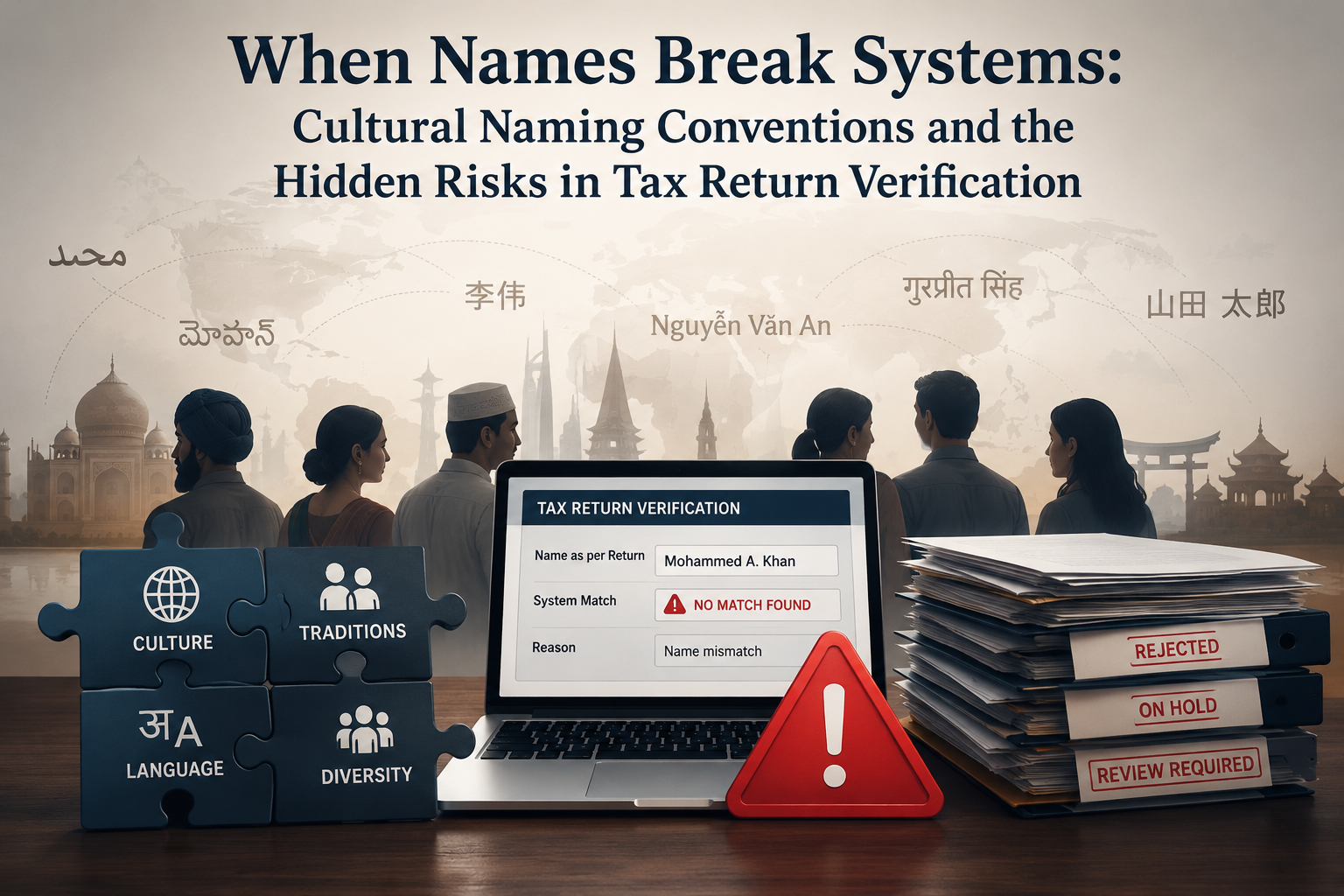
When Names Break Systems Cultural Naming Conventions and the Hidden Risks in Tax Return Verification
In a perfect world, a name is a stable, consistent identifier. It should match across systems, documents, and databases cleanly, predictably, and without friction. But in reality, names are cultural artifacts, not standardized data fields. And when cultural naming conventions collide with rigid administrative systems like the Internal Revenue Service (IRS), problems emerge often in the form of rejected e-files, delayed refunds, identity mismatches, and compliance flags.
For tax professionals and taxpayers alike, understanding how naming conventions vary across cultures is no longer optional. It’s operational risk management.
The Core Problem: Systems Expect Uniformity, Culture Does Not
Most U.S.-based systems—tax software, payroll processors, financial institutions—are designed around a simplified Western naming model:
First Name | Middle Initial | Last Name
This model assumes:
- One given name
- One optional middle name
- One family name (surname)
But globally and even within the U.S. this assumption breaks down quickly.
The IRS verifies tax returns primarily by matching:
- Name (as recorded with the Social Security Administration)
- Social Security Number (SSN)
If the name entered on a tax return does not exactly match SSA records, the return can be rejected at the e-file stage. Not “close enough.” Not “similar.” Exact.
That’s where cultural naming conventions create friction.
Example 1: Hispanic Naming Conventions (Double Surnames)
In many Hispanic cultures, individuals carry two surnames:
- First surname = father’s family name
- Second surname = mother’s family name
Example:
Full legal name:
Juan Carlos Rodríguez García
- Rodríguez = paternal surname
- García = maternal surname
Where it breaks:
- Some systems expect only one last name
- Some taxpayers drop the second surname informally
- Some reverse the order unintentionally
- Some don’t realize which surname is primary
Real-world issue:
A taxpayer files as Juan C. Rodríguez, but SSA records show Juan Carlos Rodríguez García.
Result:
- E-file rejection due to name mismatch
- Manual correction required
- Potential delays in refund processing
And here’s the kicker, Dyron you already hinted at it:
In some cases, the individual doesn’t even know their full legal name as recorded with SSA.
That’s not rare. It happens more than people think.
Example 2: Hyphenated and Married Names
Marriage introduces another layer of complexity especially when individuals:
- Hyphenate last names
- Use maiden names professionally
- Change names but don’t update SSA records
Example:
Legal name (SSA):
Emily Johnson-Smith
Filed name:
Emily Smith
Result:
Mismatch → rejection
Even worse:
- W-2 may say “Johnson-Smith”
- Tax return says “Smith”
- SSA has outdated or different version
Now you’ve got a three-way inconsistency.
Example 3: Asian Naming Order Differences
In several Asian cultures (e.g., Chinese, Korean), the family name comes first, followed by the given name.
Example:
Original format:
Wang Xiaoming
- Wang = family name
- Xiaoming = given name
U.S. system expectation:
First Name = Xiaoming
Last Name = Wang
Where it breaks:
- Forms may flip the order incorrectly
- Tax software may auto-format incorrectly
- Individuals may use Westernized versions inconsistently
Result:
Mismatch between:
- Passport
- SSA records
- Tax return
And once again rejection risk.
Example 4: Mononyms (Single Names)
In some cultures (e.g., parts of Indonesia, South India), individuals may have only one name.
Example:
Name: Sukarno
No first name / last name distinction.
System problem:
Most U.S. tax systems require:
- First name
- Last name
So what happens?
Workarounds include:
- Repeating the name (Sukarno Sukarno)
- Using placeholders (FNU = First Name Unknown)
Result:
- Inconsistent records across agencies
- High audit and verification friction
- Increased likelihood of identity flags
Example 5: Apostrophes and Special Characters
Names with punctuation or diacritics often break systems that aren’t designed to handle them.
Examples:
- O’Connor
- D’Angelo
- José
- Chloë
Where it breaks:
- Some systems strip special characters
- Others retain them
- Others replace them incorrectly
Result:
“O’Connor” vs “OConnor” becomes a mismatch
Even something as small as an apostrophe can trigger:
- E-file rejection
- Identity verification requests
- Refund delays
Example 6: Middle Names vs. Compound First Names
Some cultures treat what appears to be a “middle name” as part of the first name.
Example:
Maria del Carmen López
Is “Maria” the first name?
Or is “Maria del Carmen” the full given name?
Problem:
- Taxpayer enters “Maria López”
- SSA has “Maria del Carmen López”
Mismatch.
Example 7: Name Abbreviations and Nicknames
Taxpayers frequently use informal names:
Example:
- Robert → Bob
- William → Bill
- Alejandro → Alex
IRS/SSA expectation:
Legal name only.
Result:
“Bob Smith” vs “Robert Smith” = rejection
Why This Matters (Beyond Annoyance)
This isn’t just clerical inconvenience. There are real consequences:
1. E-File Rejections
Immediate rejection means:
- Delays
- Rework
- Client frustration
2. Refund Delays
Even if accepted later, mismatches can trigger:
- Manual review
- Identity verification letters
3. Increased Audit Risk
Inconsistent identity data can raise red flags.
4. Identity Theft Flags
Name mismatches can mimic fraud patterns.
5. Compliance Breakdowns
For firms, this becomes a process integrity issue.
The Operational Insight: This Is a Systems Design Problem
Dyron, this ties directly into something you’ve been circling systems thinking.
Names are low-entropy identifiers in a high-entropy world.
Cultural variability introduces:
- Multiple valid representations of identity
- Non-standard formatting
- Inconsistent data entry behavior
But IRS systems expect:
- Deterministic, exact matches
That’s a mismatch between human reality and machine logic.
Practical Solutions for Tax Professionals
1. Always Verify Against SSA Records
Do not rely on:
- Driver’s license
- Client memory
- Prior-year returns
Ask:
“What name is on file with Social Security?”
2. Use Exact Matching (No Assumptions)
- Include all surnames if required
- Maintain spacing, hyphens, punctuation as recorded
3. Standardize Intake Forms
Include fields like:
- “Full legal name (as on SSA record)”
- “Any prior names used”
- “Name on last filed tax return”
4. Educate Clients
Many clients don’t realize:
- Their legal name differs from what they use daily
- SSA records may be outdated
5. Build Intelligent Systems
This is where your Theogony Nexus concept can shine:
- Name normalization logic
- Multi-format identity matching
- SSA-aligned validation prompts
- Risk flags for mismatch probability
Imagine:
A system that detects “Rodríguez García” vs “Rodríguez” and flags it before submission.
That’s not just convenience that’s compliance intelligence.
Final Thought: Identity Is Not Just Data
A name carries:
- Family history
- Cultural structure
- Linguistic nuance
But tax systems treat it as:
A fixed string field
Until systems evolve to better handle cultural complexity, the burden falls on professionals to bridge the gap.
And the firms that do this well?
They don’t just file returns they protect identity integrity.