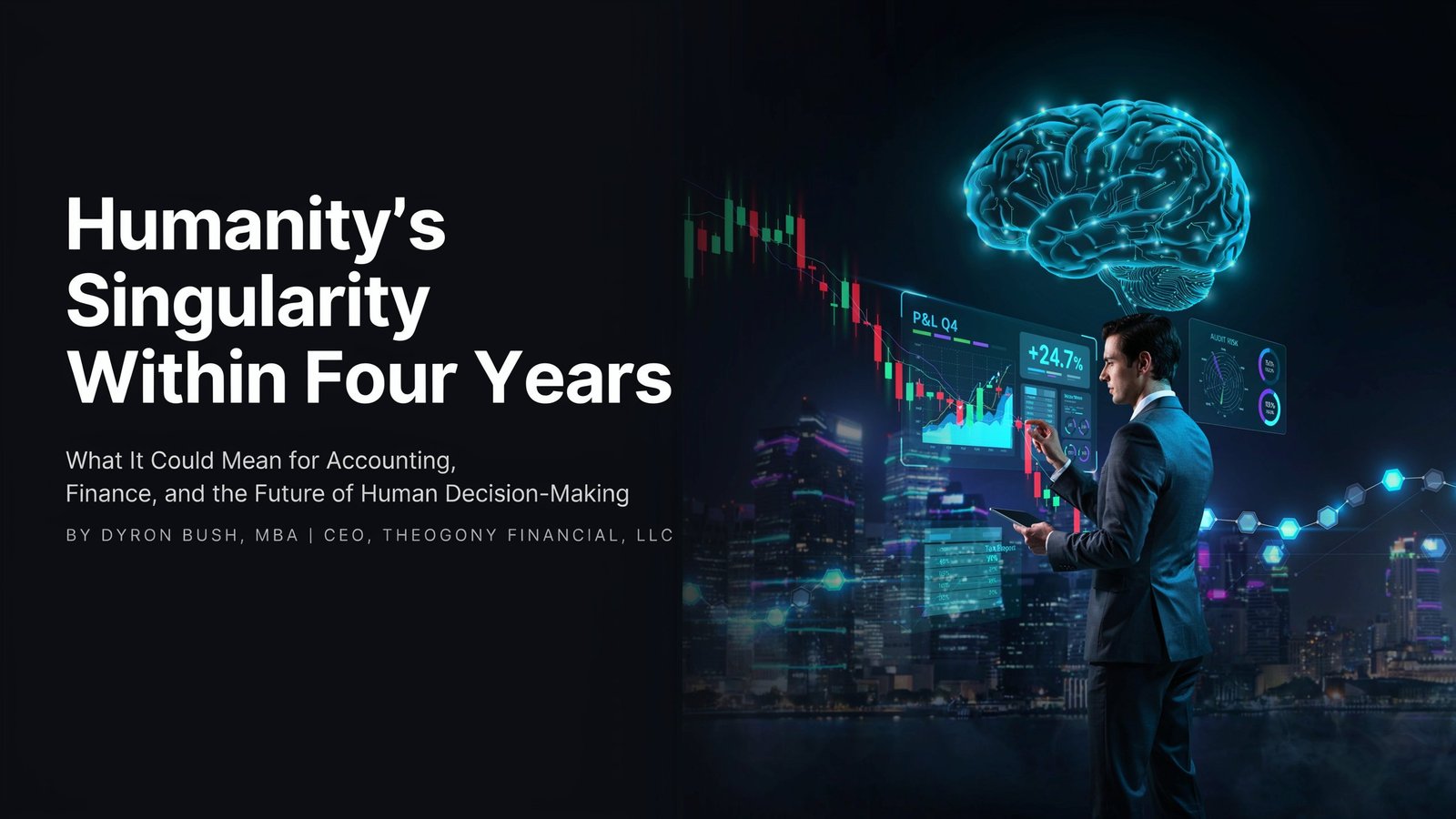
Humanity’s Singularity Within Four Years: What It Could Mean for Accounting, Finance, and the Future of Human Decision-Making
Introduction: The Four-Year Countdown
A recent article published by Popular Mechanics highlighted a provocative claim: humanity may approach technological singularity within as little as four years. The prediction is based on long-term trend analysis conducted by Translated, a language technology company that has tracked measurable improvements in artificial intelligence performance over nearly a decade.
Their research suggests AI is steadily approaching human-level performance in language translation—a task once believed to require uniquely human cognition. More importantly, translation serves as a proxy for broader capabilities involving reasoning, context, ambiguity resolution, prediction, and decision-making.
If these trend lines continue, humanity may be approaching a threshold that could fundamentally reshape every profession built upon knowledge, judgment, and information processing.
Few industries sit closer to the center of that transformation than accounting and finance.
Understanding Singularity
The technological singularity is commonly described as the moment when artificial intelligence surpasses human intelligence and begins improving itself faster than humanity can understand, regulate, or predict.
For decades, forecasts placed this milestone decades into the future.
Today, those estimates are shrinking.
Recent developments include:
- Advanced reasoning models
- Self-improving AI architectures
- Autonomous coding systems
- Multi-modal intelligence
- Human-level performance on increasingly complex benchmarks
- AI systems demonstrating emergent capabilities not explicitly programmed
Whether singularity arrives in four years, ten years, or twenty years is almost secondary.
The important reality is that AI capabilities are advancing exponentially rather than linearly.
History teaches us that exponential change appears slow until suddenly it isn’t.
The Data Behind the Prediction
One of the most compelling datasets discussed in the article involves the amount of human effort required to edit machine-generated translations.
Human Editing Time Required
| Year | Seconds Per Word |
|---|---|
| 2015 | 3.5 |
| 2022 | 2.0 |
| Human-Level Benchmark | 1.0 |
Machines are steadily requiring less human intervention.
Translation is not merely language conversion.
It requires:
- Contextual understanding
- Pattern recognition
- Ambiguity resolution
- Predictive reasoning
- Domain knowledge
These same cognitive capabilities underpin much of accounting, taxation, auditing, investing, and financial analysis.
Why Accounting Sits in the Crosshairs
For centuries, accounting has been the language of business.
The profession evolved around one central reality:
Humans were the only entities capable of interpreting financial information.
That assumption is beginning to change.
Modern accounting work increasingly consists of:
- Classification
- Reconciliation
- Pattern recognition
- Regulatory interpretation
- Risk assessment
- Decision support
Ironically, these happen to be areas where AI systems excel.
Consider the preparation of a complex tax return.
An experienced tax professional evaluates:
- Filing status
- Income characterization
- State allocation rules
- Credits and deductions
- Audit exposure
- Entity structure optimization
Each decision follows logical frameworks.
AI systems are becoming extraordinarily capable at navigating frameworks.
The Evolution of the Accounting Profession
Accounting has survived every technological revolution thrown at it.
The 1950s
Manual ledgers
The 1970s
Mainframe accounting systems
The 1980s
Spreadsheet revolution
The 1990s
ERP integration
The 2000s
Cloud computing
The 2020s
Machine learning and automation
The 2030s
AGI-assisted financial ecosystems
Historically, technology eliminated repetitive work while increasing demand for higher-value services.
The difference today is that AI is beginning to challenge both.
What Happens When AI Becomes a Senior Accountant?
Imagine an AI platform capable of:
- Reading every IRS publication instantly
- Monitoring millions of transactions simultaneously
- Performing real-time reconciliations
- Generating audit workpapers automatically
- Forecasting cash flow continuously
- Detecting fraud before losses occur
- Producing tax planning recommendations in seconds
At that point, speed ceases to be a competitive advantage for humans.
The differentiator becomes wisdom, trust, ethics, and strategic judgment.
The accountant evolves from processor to advisor.
The Future Tax Department
Today’s tax department often includes:
- Tax Director
- Tax Manager
- Senior Accountant
- Staff Accountant
Tomorrow’s department may look dramatically different.
| Function | Human Contribution | AI Contribution |
|---|---|---|
| Compliance Preparation | 10% | 90% |
| Tax Research | 15% | 85% |
| Audit Support | 30% | 70% |
| Strategic Planning | 40% | 60% |
| Scenario Modeling | 5% | 95% |
The future tax professional becomes less of a preparer and more of a strategic architect.
Banking and Finance: A Larger Transformation
Accounting may be transformed.
Finance may be reinvented.
Modern markets operate largely on information asymmetry.
Some participants possess better information than others.
That advantage creates profit opportunities.
AGI threatens that model.
If every investor has access to:
- Instant analysis
- Real-time forecasting
- Global intelligence
- Continuous risk assessment
informational advantages begin to disappear.
Possible outcomes include:
Scenario 1: Hyper-Efficient Markets
Mispricing opportunities vanish rapidly.
Scenario 2: Machine-Induced Volatility
Thousands of AI systems react simultaneously to identical information.
Scenario 3: Autonomous Financial Markets
Human traders become observers while algorithms dominate execution.
The End of Traditional Auditing?
Audits today are retrospective.
Auditors review events after they occur.
A singularity-era audit may become continuous.
Imagine:
- Every transaction monitored in real time
- Automated internal control testing
- Instant anomaly detection
- Continuous compliance validation
- Live regulatory reporting
The annual audit could eventually become as obsolete as handwritten ledgers.
What Happens to Fraud?
Historically, fraud detection has always lagged fraud creation.
AI may reverse that relationship.
Future systems could analyze:
- Behavioral deviations
- Communication patterns
- Network relationships
- Transaction timing
- Geolocation anomalies
- Organizational behavior
Fraud detection may become predictive rather than reactive.
Organizations may discover attempted fraud before losses occur.
The Phalanx 9A-1 Paradigm: Securing Finance in the Age of Singularity
As artificial intelligence advances toward increasingly autonomous decision-making, a parallel challenge emerges: securing financial systems against machine-speed attacks.
The same technologies that promise unprecedented gains in productivity, forecasting, auditing, and financial management also create new vulnerabilities. AI-generated phishing campaigns, deepfake voice cloning, synthetic identities, autonomous malware, and adaptive ransomware are rapidly evolving into threats that traditional cybersecurity frameworks were never designed to confront.
Recognizing this reality, Theogony Financial has been developing an advanced identity-governance and transaction-security architecture known as Phalanx 9A-1.
Unlike conventional security systems that rely primarily upon passwords, static multifactor authentication, or device possession, Phalanx 9A-1 approaches security as a continuously evaluated state of trust rather than a single login event.
The framework incorporates multiple independent verification layers, including:
- Behavioral authentication
- Biometric identity verification
- Hardware possession controls
- Geolocation validation
- Adaptive risk scoring
- Intent confirmation protocols
- Continuous authentication monitoring
- Duress-state identity branching
- Executive-level transaction governance
At its core lies a principle that may become essential in the age of AGI:
An attacker should not merely have to steal credentials they should have to become the authorized individual.
Traditional cybersecurity assumes that protecting access is sufficient. Phalanx 9A-1 assumes that access itself is no longer trustworthy. Every transaction, every authorization request, and every behavioral pattern become part of an ongoing verification process.
As AI systems become capable of mimicking human voices, reproducing facial characteristics, generating synthetic communications, and automating social engineering attacks at scale, static authentication methods face increasing pressure.
For high-value financial transactions, the system can require escalating verification standards based upon:
- Transaction size
- Behavioral anomalies
- Location inconsistencies
- Device trust scores
- Physiological indicators
- Environmental context
- Risk-profile deviations
Imagine a $5 billion acquisition being initiated by a multinational corporation.
Under traditional systems, the transaction might rely upon credentials, approvals, and standard banking controls.
Under a Phalanx 9A-1 framework, authorization becomes a dynamic process involving multiple independent trust anchors, continuous identity verification, and adaptive risk assessment throughout the transaction lifecycle.
In one scenario, executive credentials are compromised through an AI-assisted attack. Behavioral inconsistencies, biometric deviations, and authorization anomalies immediately trigger containment protocols.
The transaction never executes.
In another scenario, the legitimate executive initiates the transaction. Trust signals align, risk thresholds are satisfied, and the transaction proceeds seamlessly.
The distinction is profound.
The future of cybersecurity may not be stronger passwords.
It may be continuous verification of identity, intent, authority, and context.
While no cybersecurity framework can credibly claim absolute immunity from attack, architectures such as Phalanx 9A-1 dramatically increase the difficulty, cost, complexity, and likelihood of detection associated with ransomware deployment, credential theft, account takeover attacks, and unauthorized financial transfers.
As humanity approaches the singularity, financial security may increasingly depend not on what a user knows, but on continuous proof of who they are.
The Rise of the Autonomous CFO
One of the most disruptive possibilities involves executive leadership itself.
Today’s CFO manages:
- Capital allocation
- Forecasting
- Financing strategy
- Risk management
- Tax planning
An AGI-powered financial platform could theoretically perform these functions continuously and simultaneously.
The future CFO may increasingly serve as:
Chief Oversight Officer
The machine generates recommendations.
The human provides accountability.
Risks Nobody Should Ignore
The singularity may unlock prosperity.
It may also create new risks.
Employment Displacement
Knowledge workers face unprecedented automation pressure.
Concentration of Power
Organizations controlling advanced AI may accumulate enormous influence.
Regulatory Lag
Technology evolves faster than legislation.
Financial Manipulation
Machine-speed exploitation may outpace traditional oversight mechanisms.
What Accounting Professionals Should Do Today
The winners of every technological revolution were not those who resisted change.
They were those who learned to leverage it.
Recommended Actions
✓ Learn AI Prompt Engineering
✓ Master Data Analytics
✓ Develop Advisory Skills
✓ Build Industry Expertise
✓ Strengthen Client Relationships
✓ Understand AI Governance
✓ Focus on Strategic Decision-Making
My Position
The four-year singularity forecast may ultimately prove accurate.
It may prove optimistic.
It may even prove conservative.
The exact date matters less than the trajectory.
The evidence increasingly suggests that artificial intelligence is moving beyond automation and toward cognition.
Accounting, taxation, finance, auditing, banking, and investing all sit directly in the path of that transformation.
The firms that thrive over the next decade will not necessarily be those with the largest staffs or the biggest budgets.
They will be those that successfully integrate human judgment, ethical oversight, and machine intelligence into a cohesive operating model.
At Theogony Financial, we view this future not with fear, but with preparation.
Through initiatives such as Phalanx 9A-1, we are actively exploring how organizations can leverage advanced AI while simultaneously protecting themselves from the very risks that advanced AI creates.
The future belongs neither to humans alone nor machines alone.
It belongs to those who understand how to harness both.
If the trends identified in recent AI research continue, the singularity is no longer a distant thought experiment.
It is becoming a strategic business consideration.
The question is no longer whether artificial intelligence will transform accounting and finance.
The question is whether we will be prepared when it does.