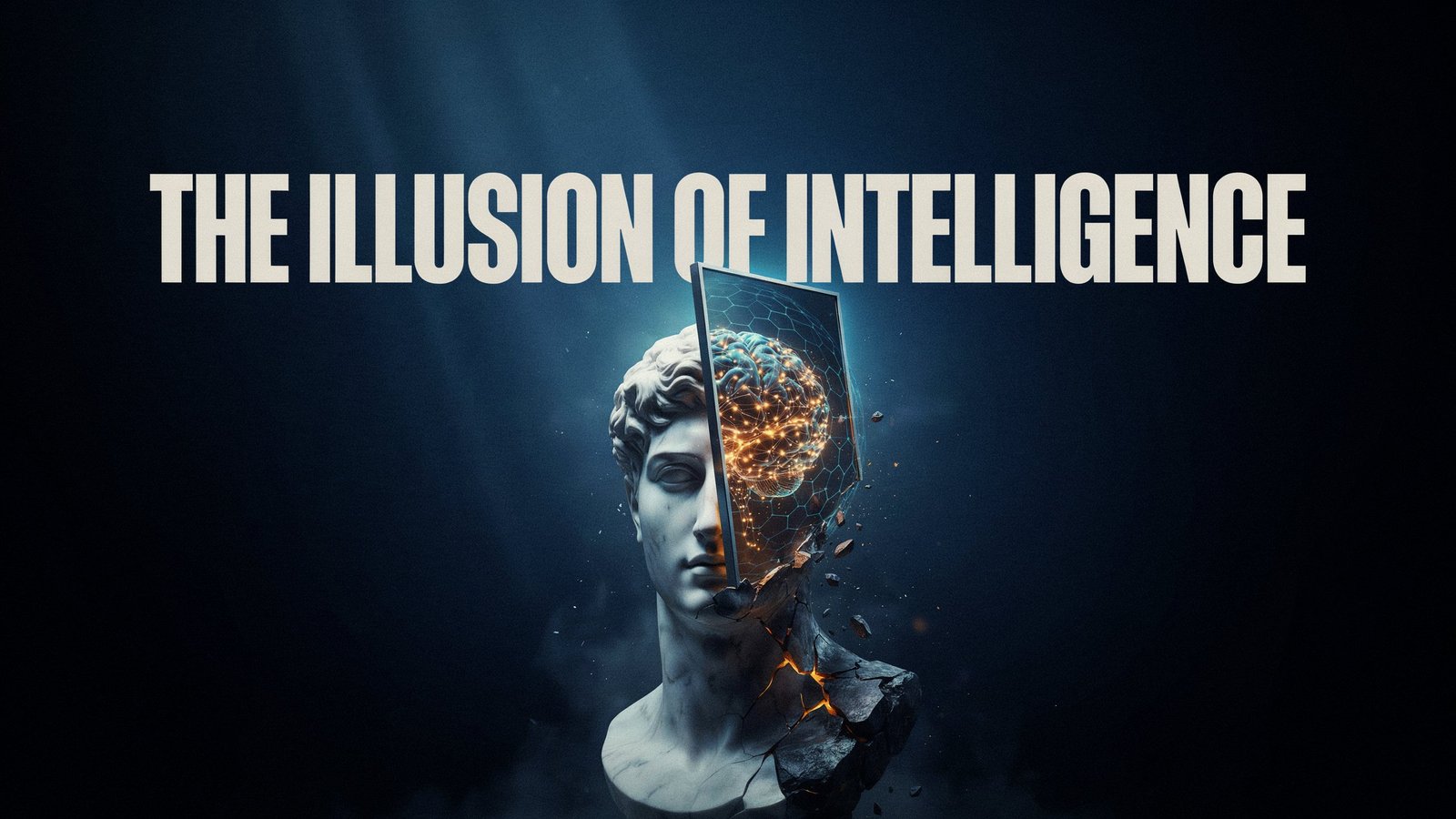
The Illusion of Intelligence: When Artificial Minds Inherit Human Stupidity
There is something profoundly ironic about humanity’s relentless pursuit of artificial intelligence. We are a species that has mastered the splitting of atoms, mapped the human genome, and developed machines capable of processing billions of calculations in seconds. Yet, we remain remarkably susceptible to superstition, tribalism, intellectual arrogance, and the seductive comfort of our own ignorance.
Now, in what may become the greatest technological undertaking in human history, we have decided to reproduce our intelligence artificially.
I find the ambition fascinating. I find the assumptions behind it considerably more troubling.
Before celebrating the emergence of artificial intelligence as humanity’s crowning intellectual achievement, I believe we should confront a rather uncomfortable question: What exactly are we reproducing?
Are we creating intelligence, or are we industrializing the very cognitive deficiencies that have plagued human civilization for millennia?
The distinction is not merely philosophical. It is existential, economic, and increasingly unavoidable.
The Intellectual Narcissism of Creation
Human beings have always demonstrated an extraordinary talent for confusing technological capability with intellectual superiority.
We build increasingly sophisticated instruments and subsequently congratulate ourselves on becoming increasingly sophisticated beings.
But technological advancement does not necessarily represent philosophical maturity.
The invention of the printing press did not eliminate ignorance. The expansion of universities did not eradicate irrationality. The development of global communications did not produce global understanding.
Indeed, one might reasonably argue that modern technology has simply provided ignorance with unprecedented distribution capabilities.
A poorly conceived argument that once circulated among a handful of individuals can now reach millions before breakfast.
And artificial intelligence threatens to accelerate this phenomenon.
I am not suggesting that AI is inherently unintelligent. I am questioning the intellectual foundations upon which its apparent intelligence rests.
Large language models learn statistical relationships from enormous collections of human-generated information. Their training material contains scientific discoveries, philosophical treatises, mathematical proofs, historical records, propaganda, fabricated narratives, and countless expressions of human misunderstanding.
The machine does not inherit human stupidity in the biological sense. It inherits the informational environment that human beings have constructed.
And that environment is anything but intellectually pristine.
We should therefore distinguish between a machine capable of producing convincing answers and a system capable of reliably establishing truth.
The two are not synonymous.
The Machinery of Manufactured Certainty
One of the most revealing characteristics of contemporary artificial intelligence is its capacity to generate authoritative explanations that may nevertheless be incorrect.
The industry calls these errors hallucinations.
I find the terminology interesting because it unintentionally exposes a striking parallel between artificial and human cognition.
Human beings routinely manufacture certainty from incomplete information.
We invent explanations for events we do not understand. We selectively interpret evidence that reinforces existing beliefs. We rationalize decisions after making them. We mistake confidence for competence and repetition for verification.
Artificial intelligence can reproduce analogous patterns in its outputs, although the underlying mechanisms differ.
A language model may generate a nonexistent legal citation, misrepresent a scientific conclusion, or fabricate a historical detail while presenting the information with extraordinary linguistic confidence.
But humans have been doing the rhetorical equivalent for centuries.
The difference is scale.
A mistaken individual may mislead a room. An automated system deployed across millions of interactions can distribute similarly persuasive inaccuracies with industrial efficiency.
And here lies one of my central concerns.
We are constructing machines capable of sounding more certain than the evidence permits, for a civilization already addicted to certainty.
The danger is not simply that AI may be wrong.
The danger is that human beings may gradually surrender the responsibility to determine
whether it is right.
Intelligence Without Wisdom
I have long considered skepticism an essential component of intellectual integrity.
Not skepticism as reflexive opposition to every proposition, but skepticism as the disciplined refusal to confuse assertion with demonstration.
Voltaire captured a related principle when he observed:
“Doubt is not a pleasant condition, but certainty is absurd.”
That sentiment becomes particularly relevant when discussing artificial intelligence.
An intelligent system should not merely produce answers. It should help identify uncertainty, distinguish evidence from inference, and recognize the boundaries of its own reliability.
Yet commercial incentives frequently reward the opposite characteristics.
Consumers want speed. Corporations want efficiency. Investors want scalability. Executives want measurable productivity improvements.
Few stakeholders are eager to finance a machine that repeatedly responds, “The available evidence is insufficient to reach a defensible conclusion.”
But sometimes that is precisely the most intelligent answer.
Wisdom requires more than the ability to retrieve, synthesize, and communicate information.
It requires judgment concerning the limitations of that information.
It requires an appreciation of consequences.
And it requires the intellectual humility to acknowledge that some questions cannot be resolved simply because computational resources have increased.
I can calculate the probability of a financial downturn using sophisticated models. I can analyze historical correlations, liquidity conditions, credit spreads, and market volatility.
But no amount of mathematical sophistication transforms a probabilistic forecast into an inevitable outcome.
A model remains a model.
Reality is under no obligation to conform to its assumptions.
The Algorithmic Inheritance of Human Prejudice
Consider another uncomfortable reality.
Artificial intelligence does not emerge from an intellectually neutral civilization.
Human history is filled with discrimination, institutional exclusion, distorted narratives, economic exploitation, and competing claims of cultural superiority.
These patterns are embedded throughout the records from which AI systems may learn.
Training procedures, data curation, evaluation methods, and safety mechanisms can mitigate some of these problems. They do not automatically eliminate them.
Consequently, algorithmic systems can reproduce or amplify disparities if their developers fail to identify and correct the relevant mechanisms.
I find it particularly ironic that organizations frequently describe artificial intelligence as objective merely because it is computational.
Mathematics can be objective within its defined assumptions.
The selection of those assumptions is not necessarily objective.
Who determines which information is authoritative?
Who establishes acceptable error rates?
Who defines fairness?
Who decides which outcomes constitute successful performance?
These are not exclusively engineering questions.
They are questions involving ethics, institutional power, economics, and human judgment.
An algorithm does not become impartial simply because its decision-making process is difficult to understand.
Opacity is not objectivity.
And automation is not absolution.
The Economics of Artificial Omniscience
As a financial professional, I find the economics surrounding artificial intelligence nearly as fascinating as the technology itself.
Corporations are committing enormous resources to data centers, semiconductor infrastructure, advanced networking equipment, and specialized computing systems.
The underlying expectation is that artificial intelligence will eventually generate productivity improvements and economic returns sufficient to justify these investments.
That proposition may prove correct in numerous applications.
But I question the tendency to treat technological possibility as financial inevitability.
History repeatedly demonstrates that revolutionary technologies can coexist with speculative excess.
Railroads transformed transportation. Telecommunications transformed communication. The internet transformed commerce.
None of those achievements guaranteed that every company financing the transformation would survive, much less produce attractive investment returns.
The same distinction applies to artificial intelligence.
A technology can fundamentally reshape civilization while simultaneously destroying enormous quantities of speculative capital.
The technological thesis and the investment thesis are separate propositions.
Unfortunately, financial markets often merge them into a single seductive narrative.
Artificial intelligence will change everything.
Therefore, every extraordinary valuation is justified.
Therefore, every infrastructure expansion is necessary.
Therefore, every capital expenditure will eventually produce an adequate return.
I reject that progression of assumptions.
Each claim requires independent examination.
The existence of transformative potential does not eliminate the necessity of financial discipline.
The Abdication of Human Judgment
Perhaps the most consequential risk associated with artificial intelligence is neither unemployment nor machine autonomy.
It is intellectual dependency.
As AI becomes increasingly integrated into financial analysis, medical decision support, legal research, education, and corporate governance, human beings may become progressively less inclined to independently evaluate the information placed before them.
This phenomenon is often described as automation bias.
When a system consistently produces useful results, people may begin to trust it beyond the circumstances in which that trust is justified.
The resulting danger is subtle.
We do not necessarily lose our capacity to reason.
We lose the habit of exercising it.
A financial analyst who accepts machine-generated conclusions without examining assumptions has not enhanced professional judgment. That analyst has outsourced it.
An executive who treats an algorithmic recommendation as an unquestionable directive has not eliminated accountability. The executive has merely obscured it.
And a society that confuses convenient answers with verified knowledge risks becoming technologically advanced while remaining intellectually stagnant.
I refuse to regard that outcome as progress.
Can Artificial Intelligence Transcend Its Creators?
There is, however, another possibility.
Artificial intelligence may eventually help humanity overcome certain cognitive limitations rather than merely reproduce them.
Machines can identify patterns that human beings overlook. They can examine relationships across vast datasets, test hypotheses at scale, and reveal inconsistencies in arguments that appear persuasive to ordinary observers.
Properly designed and rigorously evaluated systems can improve decision-making.
That possibility deserves serious consideration.
But transcendence is not automatic.
A system trained on human knowledge need not remain permanently confined to human conclusions. Scientific methods, external verification, experimental feedback, and improved reasoning architectures can enable discoveries beyond the information originally supplied.
The essential issue is whether we design these systems to pursue reliable understanding or merely to satisfy human expectations.
I want artificial intelligence that challenges my assumptions.
I want it to identify weaknesses in my reasoning.
I want it to distinguish what is known, what is probable, what is speculative, and what remains unknowable with available evidence.
I do not need a machine that flatters my intelligence.
Human civilization already possesses an abundant supply of institutions willing to perform that function.
The Final Irony
I suspect future generations will judge the artificial intelligence revolution by criteria considerably different from those dominating today’s financial headlines.
They may not care which corporation first achieved a particular benchmark or which semiconductor manufacturer briefly commanded the highest market valuation.
They may instead ask whether artificial intelligence improved humanity’s capacity to distinguish truth from fiction.
Did it strengthen scientific inquiry?
Did it improve institutional accountability?
Did it reduce preventable errors?
Did it make human beings more intellectually independent, or merely more dependent upon systems they could no longer adequately evaluate?
Those are the questions that interest me.
I do not fear machines becoming intelligent.
I fear humanity becoming so enamored with artificial intelligence that it abandons the intellectual obligations accompanying its creation.
For all our technological accomplishments, we remain a species remarkably skilled at constructing elaborate explanations for things we barely understand.
Artificial intelligence may eventually become one of our greatest instruments of discovery.
Or it may become the most sophisticated mirror ever constructed, reflecting our brilliance, prejudice, arrogance, curiosity, and ignorance with unprecedented clarity.
The outcome remains uncertain.
And unlike those who insist that the future of artificial intelligence is already settled, I consider that uncertainty intellectually healthy.
Perhaps the greatest danger of artificial intelligence is not that machines will become more like humans, but that humanity will mistake its own intellectual reflection for something divine.
And should that happen, we will have accomplished something extraordinary.
We will have created an artificial intelligence sophisticated enough to imitate human reasoning, only to demonstrate that its creators never fully mastered the discipline themselves.
Quelle ironie.
Dyron Bush
The Ledger of Life