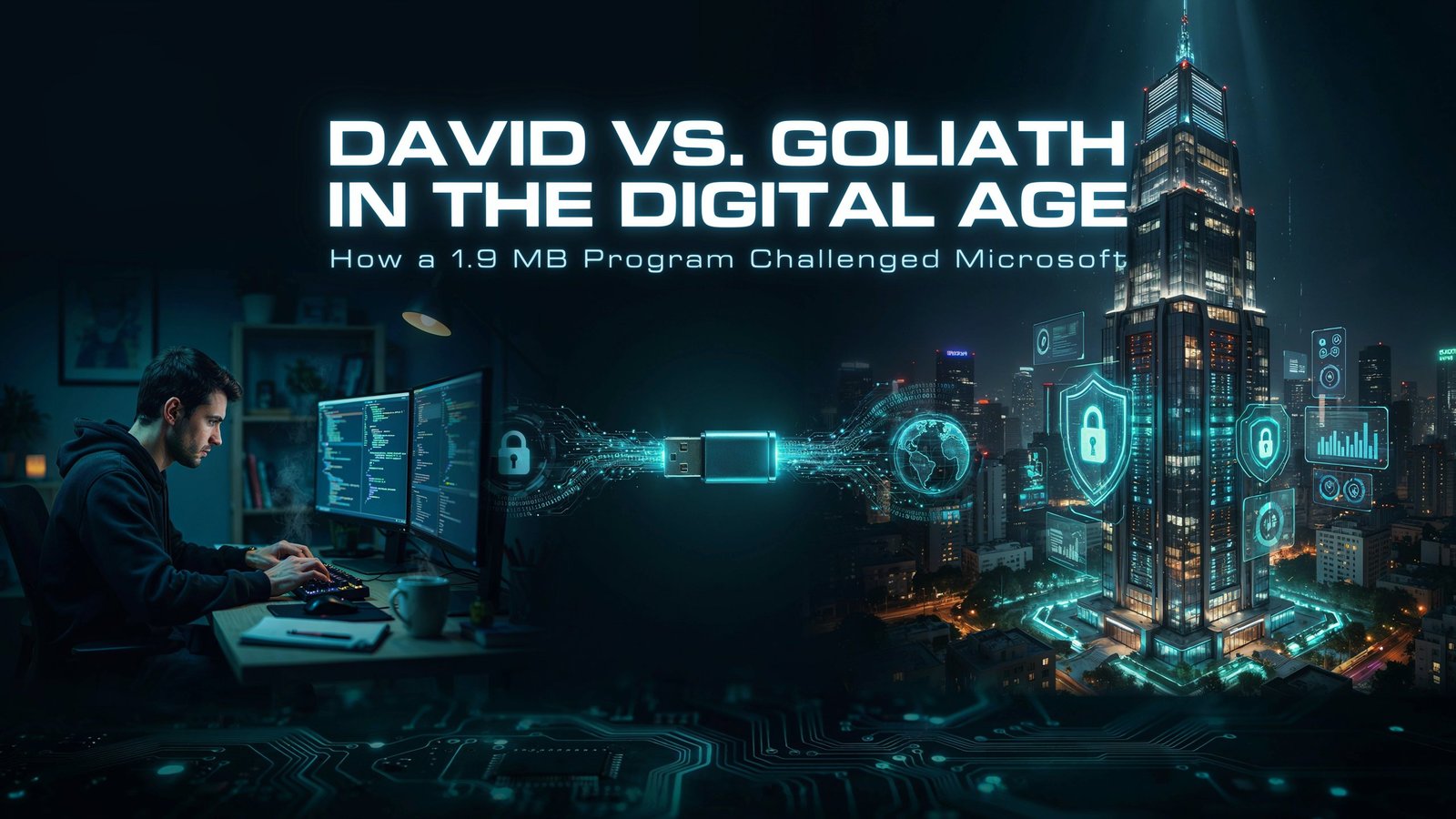
David vs. Goliath in the Digital Age: How a 1.9 MB Program Challenged Microsoft
Introduction
David vs. Goliath – In an era dominated by trillion-dollar technology corporations, most people assume innovation flows from massive research departments, billion-dollar budgets, and armies of software engineers. The prevailing belief is simple: bigger companies create bigger innovations.
Yet history repeatedly demonstrates that some of the most disruptive ideas emerge from a single individual armed with little more than expertise, determination, and a willingness to challenge convention.
From the early days of personal computing to modern open-source software, countless examples show that innovation does not always come from the top. Sometimes it emerges from passionate individuals who see problems differently and refuse to accept limitations imposed by larger organizations.
The ongoing conflict between Microsoft and the open-source utility Rufus represents one of the clearest examples of this phenomenon in modern computing.
At the center of the story is a remarkable asymmetry: a single developer maintaining a 1.9-megabyte program that has been downloaded more than 200 million times, repeatedly frustrating the objectives of one of the largest software companies in human history.
This is more than a software story. It is a story about power, ownership, freedom, and the future of personal computing.
The Tool That Was Never Supposed to Matter
Rufus began as a simple utility designed to create bootable USB drives.
Created by software developer Pete Batard in 2011, the tool was intended to solve a practical problem. Users needed a fast, reliable way to create bootable installation media for operating systems and recovery environments.
Unlike many enterprise solutions, Rufus required no installation, was completely portable, and was distributed under an open-source license.
Its design philosophy was straightforward:
- Lightweight
- Fast
- Reliable
- Free
- Accessible to everyone
For years, Rufus occupied a relatively obscure position within the technology ecosystem.
IT professionals, system administrators, repair technicians, cybersecurity specialists, and Linux enthusiasts relied upon it because it worked exceptionally well.
There was no controversy.
No grand ideological battle.
No corporate confrontation.
Just a useful tool solving a useful problem.
For many users, Rufus became the default solution whenever they needed to install Windows, Linux, or recovery tools from a USB drive.
Then Windows 11 arrived.
And everything changed.
The Beginning of the Conflict
In 2021, Microsoft announced that Windows 11 would require TPM 2.0 (Trusted Platform Module), a security feature embedded in newer hardware.
Microsoft argued that TPM 2.0 would strengthen system security through:
- Hardware-backed encryption
- Secure Boot verification
- Protection against firmware attacks
- Improved credential security
- Better ransomware resistance
From a purely technical perspective, Microsoft’s argument was sound.
Cybersecurity threats were becoming increasingly sophisticated, and hardware-based security mechanisms offered meaningful protection against modern attack vectors.
The problem was scale.
Millions of perfectly functional computers suddenly found themselves labeled “incompatible.”
Many of these systems were only a few years old and possessed more than enough processing power, memory, and storage capacity to run Windows 11 smoothly.
Yet according to Microsoft’s official requirements, they were no longer eligible.
Estimates suggested that between 240 million and 400 million PCs worldwide were effectively stranded by the new requirements.
These were not broken machines.
They were not obsolete machines.
Many remained powerful enough to run modern applications with ease.
Yet users were told they could not officially upgrade.
Microsoft’s message was straightforward:
Buy newer hardware or remain on Windows 10.
For consumers, businesses, schools, and organizations managing large fleets of computers, this represented a significant challenge.
Hardware upgrades cost money.
A lot of money.
Pete Batard offered a different answer.
The Bypass That Changed Everything
Batard integrated bypass functionality directly into Rufus.
The software allowed users to install Windows 11 on systems that Microsoft had declared unsupported.
Suddenly, TPM requirements, Secure Boot requirements, and memory restrictions became optional rather than mandatory.
Users could continue using hardware that Microsoft had effectively left behind.
Rufus also introduced several additional features that users quickly embraced.
The software allowed users to:
- Avoid Microsoft account requirements during installation
- Create traditional local accounts
- Disable automatic BitLocker encryption
- Download Windows installation files directly
- Customize installation settings before deployment
- Streamline the overall installation experience
What made this remarkable was not simply that Rufus bypassed Microsoft’s restrictions.
It was how easy it made the process.
A few clicks could accomplish what Microsoft described as impossible or unsupported.
The implications extended far beyond technical convenience.
This became a debate about ownership.
Who truly controls your computer?
The person who purchased it?
Or the company that created its operating system?
For many users, Rufus represented an assertion of digital ownership.
It allowed individuals to make decisions about their own hardware rather than accepting decisions made on their behalf.
A Pattern Emerges
What followed was a technological cat-and-mouse game.
Microsoft modified Windows installers to block Rufus bypass methods.
Batard developed new techniques.
Microsoft hardened APIs and restricted access methods.
Batard patched Rufus and restored functionality.
Microsoft closed one door.
Rufus found another window.
Microsoft closed the window.
Rufus found a different entrance.
The pattern repeated multiple times.
This ongoing cycle became one of the most fascinating examples of modern software adaptation.
Each update introduced new obstacles.
Each obstacle inspired new solutions.
The significance of this cycle reveals a fundamental truth about technology security and software freedom.
Large organizations often face a difficult challenge.
They must defend against every possible workaround.
Independent developers need only discover one successful alternative.
This asymmetry can make even enormous corporations vulnerable to determined individuals.
It is a dynamic that appears repeatedly throughout technological history.
Why Open Source Changes the Equation
The most fascinating aspect of this conflict is that Microsoft cannot simply eliminate Rufus.
Rufus is open source.
Its code is publicly available for anyone to inspect, modify, improve, or redistribute.
Thousands of developers can review changes, identify problems, and contribute solutions.
If one developer stops maintaining the project, others can continue it.
This creates resilience rarely found in proprietary software.
Traditional software companies often rely on centralized control.
Open-source projects distribute knowledge among communities.
The result is similar to biological evolution.
When one pathway becomes blocked, alternative pathways emerge.
The collective intelligence of a global developer community often proves remarkably adaptive.
Open source transforms software from a product into an ecosystem.
That distinction matters.
Because ecosystems are often far more resilient than organizations.
Security Versus Freedom
It would be intellectually dishonest to portray Microsoft as a villain in this story.
TPM 2.0 does provide genuine security benefits.
Modern computing environments face increasing threats from:
- Ransomware
- Firmware attacks
- Credential theft
- Supply chain compromises
- Advanced persistent threats
Hardware-based security can help defend against these risks.
Many security researchers agree that Microsoft’s objectives were technically reasonable.
Yet reasonable intentions do not automatically justify every implementation.
The controversy stems from how those requirements were imposed.
Consumers purchased computers under one set of assumptions.
Years later, those same computers were effectively declared insufficient despite remaining fully functional.
The debate therefore extends beyond security.
It enters the realm of:
- Consumer rights
- Environmental sustainability
- Digital autonomy
- Hardware ownership
- Software freedom
The Hidden Cost of Forced Obsolescence
One overlooked aspect of the Windows 11 transition involves environmental impact.
If hundreds of millions of computers are replaced prematurely, the resulting electronic waste becomes enormous.
Electronic waste is already one of the fastest-growing waste streams in the world.
Discarded computers contain:
- Plastics
- Metals
- Rare earth elements
- Hazardous materials
Manufacturing replacement hardware requires mining operations, transportation networks, industrial production, and significant energy consumption.
Every new device carries an environmental cost.
From this perspective, Rufus does more than help users save money.
It potentially delays one of the largest hardware replacement cycles in computing history.
The environmental implications alone deserve serious consideration.
When technology decisions affect hundreds of millions of devices, even small policy changes can produce massive global consequences.
The Broader Impact on the Computing Industry
The Rufus story has implications that extend far beyond Windows installations.
It highlights a growing tension throughout the technology industry.
Increasingly, software companies seek greater control over how users interact with their hardware.
This trend appears in:
- Smartphones
- Gaming consoles
- Smart TVs
- Connected vehicles
- Cloud-based services
Manufacturers often justify these controls through security, stability, and user experience improvements.
Critics argue that such measures reduce user autonomy.
The conflict between Microsoft and Rufus reflects this larger industry-wide debate.
As technology becomes more integrated into everyday life, questions of control become increasingly important.
A Lesson Beyond Technology
The Rufus story is not really about USB drives, TPM chips, or Windows installations.
It is about power.
Specifically, it is about how power operates in the digital age.
We often assume that resources determine outcomes.
- More money.
- More employees.
- More infrastructure.
- More market share.
These advantages should guarantee victory.
Yet innovation frequently ignores conventional expectations.
A single individual can sometimes outperform organizations thousands of times larger.
History offers countless examples.
Open-source software challenged proprietary operating systems.
Independent creators disrupted traditional media.
Small startups transformed entire industries.
The internet has repeatedly demonstrated that leverage matters more than size.
Pete Batard’s 1.9-megabyte application embodies this principle.
It represents the idea that expertise, persistence, and community support can occasionally rival corporate scale.
Final Thoughts
Whether one agrees with Microsoft’s security policies or supports Rufus’s philosophy of user freedom, the broader lesson remains compelling.
Technology is ultimately about control.
- Control over hardware.
- Control over software.
- Control over data.
- Control over the choices available to users.
The battle between Microsoft and Rufus highlights a growing tension in modern computing between centralized authority and individual autonomy.
Neither side possesses a perfect argument.
Security matters.
Freedom matters.
Stability matters.
Choice matters.
But perhaps the most remarkable fact is this:
A tool smaller than many email attachments continues to challenge policies established by one of the largest corporations in the world.
That reality serves as a reminder that innovation is not measured by company valuation, employee count, or market capitalization.
Sometimes, it is measured in megabytes.
And sometimes, 1.9 megabytes is enough to change the conversation.
As technology continues to evolve, stories like Rufus remind us that the future is not shaped solely by corporations.
It is also shaped by individuals willing to question assumptions, challenge limitations, and empower users.
In the digital age, David still has a chance against Goliath.
And sometimes, David writes better software.